
Carrara marble is the name most people know first when they think of white Italian stone. It is quarried in and around the town of Carrara in the Apuan Alps of Tuscany, the most famous marble quarrying region in the world, and it has been cut from those mountains since Roman times. For importers, fabricators, and project specifiers, Carrara is the dependable workhorse of the white marbles: the most affordable of the celebrated Italian whites, the most widely available, and the one you can source in volume without waiting on a single rare block.
Stonelink has supplied Carrara and other natural stones since 2012 from our Shuitou & Xiamen bases, with 60,000 m² of inventory across 2,000+ designs and shipments to 80+ countries. This guide explains what Carrara actually is, how it differs from Calacatta and Statuario, where it works best, what it costs, and exactly how to specify and import it for a commercial or residential project.
Origin: The Mountains Behind the Name
Carrara sits in northwestern Tuscany, where the Apuan Alps rise straight out of the Ligurian Sea. The marble here is not a small deposit; it is a mountain range made largely of stone. The Romans called it marmor Lunensis and quarried it for temples, baths, and monuments. Michelangelo walked these quarries looking for the flawless blocks he would carve into David and his Pietà.
What makes Carrara unique is scale and continuity. Unlike rarer marbles that come from a handful of small seams, Carrara has been produced continuously for two thousand years and still supplies the bulk of the world’s white marble. That history matters to buyers because it means established quarrying infrastructure, predictable supply, and a global grading vocabulary everyone in the trade understands. When you say “Carrara,” suppliers in Italy, China, and every importing market know the stone you mean.
Geology: Why Carrara Looks the Way It Does
Carrara is a metamorphic limestone. Around 200 million years ago, the region sat under a warm, shallow sea that laid down thick beds of marine limestone. Tectonic compression and heat during the formation of the Alps recrystallized that limestone into a dense, sugary, interlocking mass of calcite crystals. The result is a fine-grained, relatively uniform white stone.
The grey veining comes from impurities — mainly clay, silicates, and iron oxides — that were present in the original sediment or introduced along fracture lines as mineral-rich fluids moved through the rock. Because these impurities are spread thin and evenly through the Carrara formation, the veining tends to be subtle and linear rather than bold and chaotic. That geological evenness is exactly why Carrara reads as calm and consistent compared to its flashier Italian cousins.
Appearance: Quiet, Cool, and Consistent
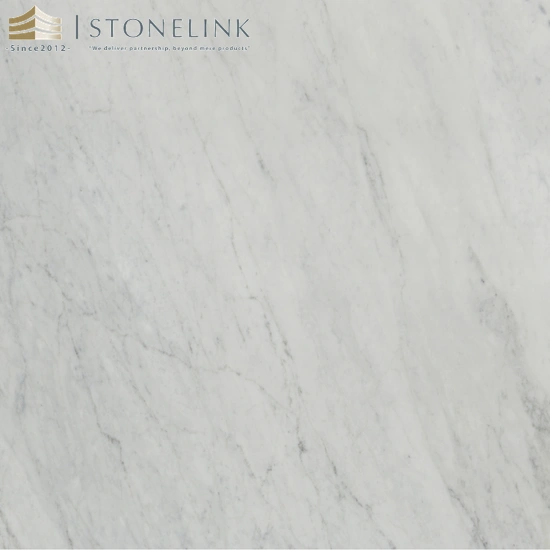
Carrara marble is defined by restraint. The ground is a soft, cool white or very light grey, and the veining is feathery and linear — fine grey lines that drift across the surface rather than dominate it. Where Calacatta throws dramatic, artistic movement at you, Carrara whispers. The overall impression is clean, even, and timeless.
This uniformity is a selling point, not a weakness. On large floors or wall runs, Carrara’s quieter pattern reads as calm and continuous, without the busy contrast that can tire the eye across a big area. It is the white marble that looks right in both a 16th-century chapel and a 2026 bathroom renovation. Buyers who want a bright, classic white surface without a loud pattern almost always land on Carrara.
Carrara vs Calacatta vs Statuario
These three are the white Italian marbles buyers ask about most, and they come from neighboring quarries in the same Apuan Alps. The short version:
- Carrara — cool white to light grey, subtle feathery grey veining, the most uniform and the most affordable of the three.
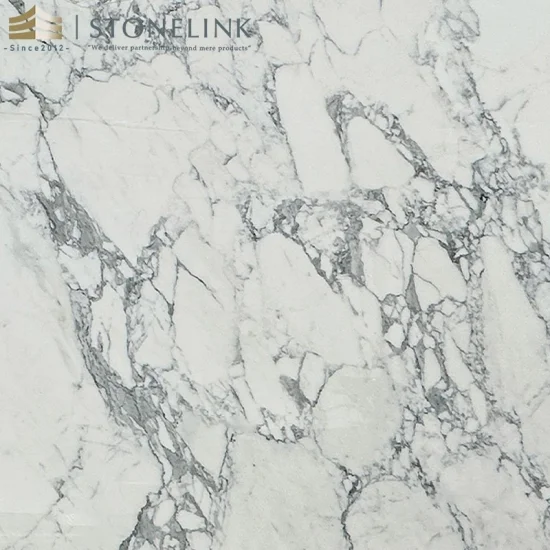
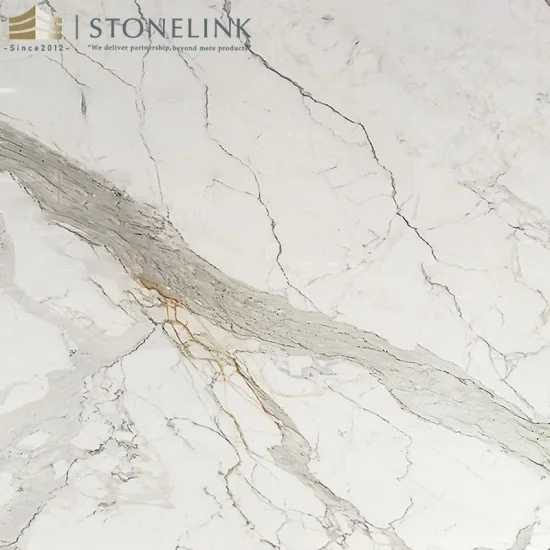
- Calacatta — warmer, creamier white with bold, dramatic grey-and-gold veining; more expensive and more striking.
- Statuario — the brightest, most optical white with fine, disciplined grey veins; rarer and typically the priciest.
If you want the full side-by-side on the two premium grades, see our guide to Calacatta vs Statuario, our dedicated Calacatta marble page, and our Statuario marble overview. The practical rule for budgeting: Carrara is the value option, Calacatta the statement option, and Statuario the luxury-spec option.
Popular Carrara Varieties
Within the Carrara family, a few names come up constantly in trade and specification:
Bianco Carrara. The classic, most-recognized grade: a clean cool white with light grey veining. It is the default “Carrara” most buyers picture and the one specified most often for flooring and wall cladding.
Carrara C. A commercial grading tier. Italian marble is often classed by background whiteness and vein contrast (C, CD, D and similar codes), where “C” denotes a whiter, cleaner background with lighter veining and higher commercial quality. Carrara C is the grade most importers ask for when they want a bright, consistent look at a workable price.
Statuario-look and Calacatta-look alternatives. For projects that want a brighter white or bolder vein at Carrara’s budget, many suppliers offer Carrara-based selections sorted to resemble Statuario or Calacatta. These are still Carrara stone, just hand-picked blocks that imitate the rarer looks. They are a smart value play when the budget cannot stretch to true Italian Statuario or Calacatta.
Ideal Applications
Carrara’s even tone and broad availability make it one of the most versatile stones in the catalog:
- Flooring. Large-area floors are where Carrara shines. The quiet pattern avoids visual fatigue across hundreds of square meters, and slabs or tiles are easy to source in volume.
- Countertops. Polished Carrara makes elegant, bright kitchen and bathroom counters. Be realistic about etching (see maintenance below) and many buyers choose honed finishes for busy kitchens.
- Bathrooms. Walls, vanities, and shower surrounds in Carrara read as spa-like and classic. It pairs effortlessly with chrome, nickel, and soft grey palettes.
- Sculptural and architectural use. Because it is the same stone sculptors have used for centuries, Carrara remains a first choice for carved elements, fireplaces, columns, and bespoke architectural detail.
For a broader look at which whites suit cooking spaces, see our best marble for kitchen guide.
Durability and Maintenance
Carrara is genuine marble, which means it is calcium carbonate. That chemistry dictates its care:
- Acid etching. Lemon juice, vinegar, wine, and many cleaners will dull the surface on contact. This is etching, not staining, and it happens to every true marble. Use pH-neutral cleaners and wipe spills promptly.
- Sealing. A penetrating sealer slows staining and should be reapplied periodically (typically annually in kitchens, less often in low-traffic areas). Sealing does not prevent etching.
- Honed vs polished. Polished Carrara is glossy and shows etch marks more obviously. Honed Carrara has a matte, soft finish where etching is far less visible — a common choice for kitchen counters and high-traffic floors. Decide the finish early, because it changes fabrication and sealing routines.
- Scratch resistance. At Mohs 3, marble scratches more easily than granite or quartzite. Use cutting boards and avoid dragging abrasive objects across the surface.
None of this makes Carrara impractical. It makes it a material that rewards sensible specification and care, which is the same story for every natural marble.
Price Drivers: Why Carrara Is the Value Option
Among the white Italians, Carrara is the value play, and the reasons are structural:
- Abundant supply. The Apuan quarries produce enormous, continuous volume. More block means more competition and steadier pricing than rare stones.
- Quarry yield. Carrara yields a high percentage of usable, large-format material, lowering the cost per square meter versus Statuario, which discards far more.
- Grading flexibility. With tiers like Carrara C, buyers can dial the whiteness and vein contrast to their budget rather than paying for the cleanest possible block every time.
- Processing location. When slabs are cut and finished at efficient manufacturing hubs such as Shuitou and Xiamen, labor and logistics costs drop further versus shipping rough block or finished goods from Europe.
The result: you get a genuine Italian-origin white marble at a fraction of the Calacatta or Statuario price, with none of the long lead times those rarer stones can impose. That is why Carrara remains the default for budget-conscious commercial jobs and high-volume residential programs.
How to Buy and What to Specify
Buying Carrara well is about specifying clearly so you get the stone, the finish, and the volume you actually need. Use this checklist:
- Slab size. Standard marble slabs run roughly 2400–3000 mm long by 1200–1800 mm wide, with thicknesses of 18 mm or 20 mm for vertical and flooring use and 30 mm for heavy counters. Confirm exact dimensions per batch, as natural stone varies.
- MOQ. For container shipments, minimum order quantities are usually set per material and color. Discuss your project volume early so the supplier reserves matching blocks from the same quarry run — critical for color and veining consistency.
- Book-matching. If you want mirrored, symmetrical veining across adjacent slabs (common on feature walls and islands), request book-matched pairs and review the full layout before cutting. Carrara’s linear veins book-match cleanly.
- Finish and edge. State polished or honed, and the edge profile, in the purchase order. Changes after fabrication are costly.
- Container shipping. Slabs normally ship in 20-foot containers, with quantities depending on slab size and thickness (a typical load holds roughly 300–500 m² of 20 mm slabs). Work with your supplier on packing, crate protection, and Incoterms (FOB, CIF, DAP) so landed cost is clear.
Stonelink manufactures and supplies from Shuitou & Xiamen with 60,000 m² of inventory and 2,000+ designs, so we can show real Carrara slabs, pull book-matched sets from the same block, and consolidate a mixed container with other stones for your project. See our Carrara white marble product page, our marble manufacturer in China overview, and our full guide to importing natural stone from China for the logistics detail.
Frequently Asked Questions
Is Carrara real marble?
Yes. Carrara is genuine natural marble — a metamorphic recrystallized limestone composed mainly of calcite. It has been quarried in Tuscany since Roman times and is one of the most authentic and historic marbles on the market, not an engineered or imitation stone.
What is the difference between Carrara, Calacatta, and Statuario?
All three come from the Apuan Alps in Italy, but they differ in look and price. Carrara is a cool white to light grey with subtle, feathery grey veining and is the most affordable and widely available. Calacatta is warmer with bold grey-and-gold veining and costs more. Statuario is the brightest white with fine grey veins and is typically the rarest and priciest. Carrara is the value option of the three.
How much does Carrara marble cost?
Carrara is the most economical of the famous white Italians. Exact price depends on grade (for example Carrara C versus lower tiers), slab size, thickness, finish, and whether you buy at the slab or container level. Because it is quarried in huge volume with high usable yield, per-square-meter cost stays well below Calacatta and Statuario. Contact a supplier with your specifications for a firm quote.
Is Carrara marble good for kitchens?
It works well in kitchens for a classic, bright look, but you should plan for marble’s nature. It etches on contact with acids like lemon and vinegar, so many buyers choose a honed finish where etch marks are less visible, use cutting boards, and seal regularly. For very high-abuse prep areas, compare it against harder stones in our best marble for kitchen guide.
Does Carrara marble stain and etch?
It can stain if spills sit unsealed, which is why a penetrating sealer and prompt cleanup matter. More importantly, it etches — acid contact leaves dull marks that cleaning cannot remove, only re-honing or re-polishing can. Etching affects every true marble; sealing slows staining but not etching. Honed finishes hide etch marks better than polished ones.
Can I import Carrara marble from China?
Yes. Many importers buy Italian-origin or Carrara-type white marble that is cut, finished, and container-shipped from manufacturing hubs like Shuitou and Xiamen, which lowers processing and logistics cost. Work with an established supplier, confirm the stone’s origin and grade in writing, request slab photos, and clarify Incoterms and MOQ before ordering. Our import guide walks through the full process.
Related guides: Top 10 Marble Suppliers · Project Case Studies
Explore Our Stone Collection
Looking for the right slab for your project? Browse Stonelink’s inventory of 2,000+ designs across marble, granite, quartzite, travertine, onyx and limestone.
- Carrara White Marble
- Calacatta vs Statuario: How to Tell Them Apart
- How to Import Natural Stone from China
Ready to Source Marble?
Contact the Stonelink team to compare Carrara, Calacatta, and Statuario slabs side by side, or to request book-matched layouts and alternative whites for your budget. We ship from Shuitou & Xiamen to 80+ countries with 60,000 m² of inventory across six stone families.
Frequently Asked Questions
How can I import natural stone from China?
Most overseas buyers work with Stonelink in four clear steps. (1) Share your project specifications, drawings or inspiration photos, or choose directly from our 60,000 m² inventory of 2,000+ designs. (2) We send whole-slab high-resolution photos and short video so you can verify exact veining, color and finish before committing — bookmatching and sequence are confirmed at this stage. (3) We handle export packing (foam-protected, fumigated wooden crates), container booking and ocean freight from Xiamen or Shuitou port. (4) Goods arrive at your destination port with the full document set (commercial invoice, packing list, Bill of Lading, certificate of origin, insurance). We support both full-container-load and LCL shipments, and all communication is in English.
What is your minimum order quantity (MOQ) and lead time?
MOQ typically starts from one container (about 20–27 tons depending on slab size and thickness), and mixed sizes or products are accepted so you can consolidate an entire project in one shipment. For smaller trials we can sometimes ship an LCL (less-than-container) batch of a few slabs, though the per-unit freight is higher; ask us and we will quote both options. Standard lead time is about 15–25 days after order confirmation for in-stock materials, or longer for custom cutting and special finishes. Before shipment we provide whole-slab photos and video so you know exactly what you receive, and we can hold stock for phased deliveries. For recurring orders we offer reserved inventory and rolling production schedules to keep your supply chain steady, and we quote both FOB Xiamen/Shuitou and delivered CIF or DDP to your port.
Can you send stone samples before I place an order?
Yes. We provide samples — offcuts or small slabs — so you can verify color, finish and quality before committing to a full shipment. Samples ship worldwide by courier (DHL, FedEx or UPS), typically within 3–7 days, and the sample cost is usually credited against your first container order. For large projects we can also send a full digital package — high-resolution whole-slab photos and short videos — so your designers can spec with confidence before any physical sample moves. Tell us the exact application, dimensions and finish you need and we will pick the most representative pieces rather than random offcuts, so the sample truly reflects the batch you would receive.
Do you provide quality control and certifications?
Yes. Stonelink is a China-based natural stone manufacturer and exporter operating from the Xiamen and Shuitou stone hub since 2012, with a 60,000 m² inventory spanning 2,000+ designs and direct quarry access, shipping to 80+ countries. Every shipment is inspected for packing and quality before loading — slabs are checked for cracks, bow, thickness tolerance and finish, then crated in foam-protected, fumigated wooden packaging. We can arrange third-party inspection (SGS, Intertek and similar) and supply the documentation your destination requires: commercial invoice, packing list, Bill of Lading, certificate of origin and, where relevant, CE marking or material test reports. Tell us your certification and labeling needs (for example the EU, US, Australia or Middle East) and we will match them and pre-clear the paperwork so customs clearance goes smoothly.
How do I choose the right natural stone for my project?
Start with the application: floors and high-traffic areas favor harder stones (granite, quartzite), while marble and onyx shine in lower-abuse, design-led spaces such as feature walls and vanities. Match the finish to the mood — polished for drama, honed for calm, leathered for texture — and confirm color stability under your actual lighting, since natural stone shifts with light. For wet areas choose a denser, well-sealing material and an appropriate finish, and review whole-slab photos or video with our team before you buy. We advise free of charge based on your project’s traffic, budget and aesthetic, so you avoid expensive mismatches and rework.
What shipping terms and documents are included?
We ship FOB Xiamen or Shuitou as standard and can also quote CIF or DDP to your port, so you control insurance and freight or let us handle it end to end. We manage export packing, container booking and ocean freight, and provide the full document set: commercial invoice, packing list, Bill of Lading, certificate of origin and cargo insurance. Both full-container-load and LCL (less-than-container-load) shipments are supported, and for landlocked destinations we can arrange door-to-door multimodal transport. Tell us your delivery address and incoterm preference and we will quote a landed cost, not just an ex-works price, so there are no surprises at the border.