
Travertine and marble get lumped together by buyers who just see “natural stone” and stop there. They are both carbonate rocks, both have been used in buildings for thousands of years, and both show up in beige and white tones that look similar at a glance. But they form differently, perform differently, and suit different jobs. If you are importing or specifying either one, the differences below will save you from the wrong purchase and the returns that follow.
Stonelink has supplied both out of Shuitou & Xiamen since 2012, with 60,000 m² of inventory across six stone families and 2,000+ designs, shipped to 80+ countries. Travertine and marble sit in different parts of that catalog, and the questions importers ask about them are consistently different, so here is the clear comparison.
How They Form and What That Means
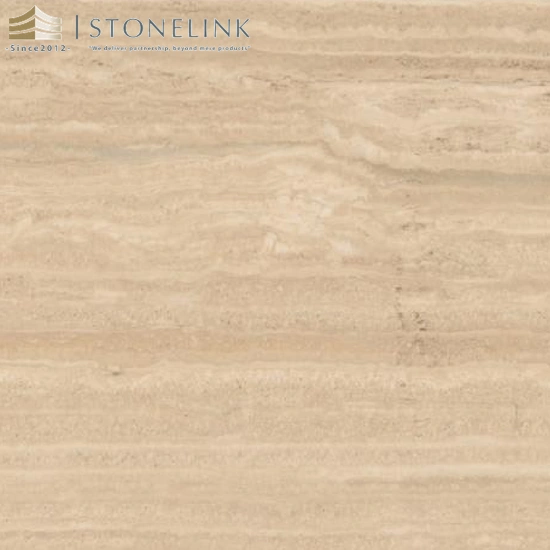
Marble is limestone that was transformed by heat and pressure underground, which is why it has a crystalline structure and can take a high polish. Travertine is a form of limestone deposited by mineral springs, building up in layers with gas bubbles that leave small voids. Those voids are the signature of travertine: a slightly porous, often pitted face that reads as soft and organic.
That formation difference is the root of every other contrast. Marble is denser and can be polished to a mirror; travertine is more open and usually finished honed, tumbled, or filled and polished to a lower sheen.
Appearance
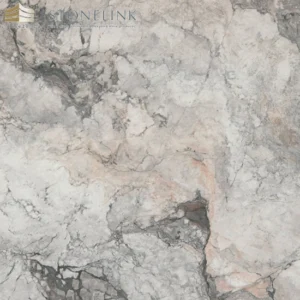
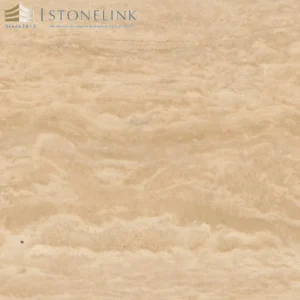
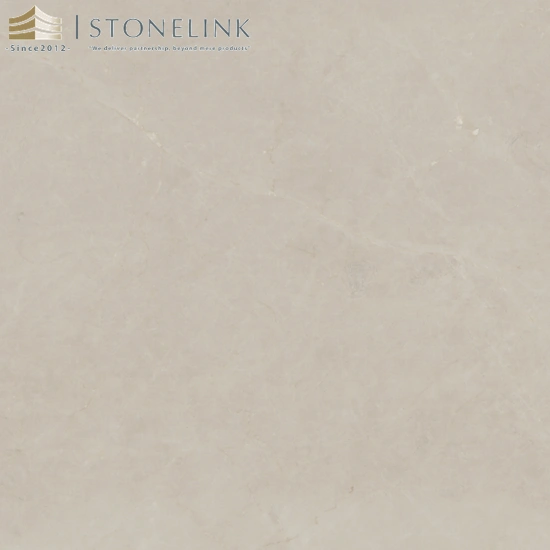
Marble shows veins, the dramatic grey or gold lines that come from mineral impurities moving through the stone. Travertine shows tones and bands rather than sharp veins, with a cloudy, layered beige or cream look. Where marble feels like art, travertine feels like earth.
Hardness and Durability
Both are relatively soft compared with granite or quartzite, and both etch on contact with acid. Marble is a touch harder and denser, so it resists abrasion a little better. Travertine’s open structure means it can chip at edges and needs filling for some applications. Neither is a good choice for a heavy-duty prep counter without realistic care expectations.
Finish and Slip
Travertine is most often supplied honed or tumbled, which gives it excellent slip resistance and a warm, matte floor feel. Marble is commonly polished for walls and honed for floors. For pool decks and wet areas, travertine is the more natural pick because its texture and fill handle moisture and grip better.
Best Uses
- Travertine: pool coping, patios, bathroom floors, shower walls, rustic or Mediterranean interiors, and any place where a warm matte stone fits.
- Marble: kitchen islands, feature walls, vanities, hotel lobbies, and anywhere bold veining or a polished finish is wanted.
Price and Availability
Within industry range, travertine is generally the more accessible material, with steady supply from several regions. Marble pricing swings widely by variety, from modest domestics to premium Italian Calacatta and Statuario. Block yield, the specific quarry, and finishing drive the final number more than the stone type alone.
Sourcing Notes for Importers
Travertine quality varies most on filling and honing consistency. A poorly filled lot leaves open pits that collect dirt; a well-filled, properly honed slab performs for decades. With 60,000 m² of inventory and direct quarry access plus global sourcing, we can hold both travertine and marble side by side so a buyer matches the stone to the job rather than guessing from photos. For large flooring projects, travertine’s lower cost and slip profile often win; for statement interiors, marble’s veining carries the space.
Frequently Asked Questions
Is travertine weaker than marble?
Travertine is generally a bit softer and more porous, so it is more prone to edge chipping and staining if left unsealed. Marble is denser and slightly harder. Neither is as tough as granite, and both need sealing, but travertine demands a little more attention to filling and maintenance.
Can travertine be polished like marble?
It can be filled and polished to a moderate sheen, but it will not reach the mirror gloss of marble because of its open, layered structure. Most buyers choose honed or tumbled travertine precisely for that matte, natural look rather than trying to make it shine.
Which is better for outdoor use?
Travertine, finished honed or tumbled, is the stronger choice for outdoor floors, pool decks, and patios because of its grip and its ability to stay cool and stable in weather. Polished marble outdoors becomes slippery when wet and shows etching fast, so it is better kept to covered or vertical applications.
Do they need the same care?
Both need a penetrating sealer and protection from acidic cleaners and foods. Travertine usually needs resealing a bit more often due to its porosity. Use pH-neutral cleaners on both, and avoid vinegar or citrus-based products that etch the surface.
Explore Our Stone Collection
Looking for the right slab for your project? Browse Stonelink’s inventory of 2,000+ designs across marble, granite, quartzite, travertine, onyx and limestone.
Ready to Source Natural Stone?
Contact the Stonelink team to compare travertine and marble slabs side by side, or to request filled and honed samples matched to your project. We ship from Shuitou & Xiamen to 80+ countries with 60,000 m² of inventory across six stone families.
Frequently Asked Questions
How can I import natural stone from China?
Most overseas buyers work with Stonelink in four clear steps. (1) Share your project specifications, drawings or inspiration photos, or choose directly from our 60,000 m² inventory of 2,000+ designs. (2) We send whole-slab high-resolution photos and short video so you can verify exact veining, color and finish before committing — bookmatching and sequence are confirmed at this stage. (3) We handle export packing (foam-protected, fumigated wooden crates), container booking and ocean freight from Xiamen or Shuitou port. (4) Goods arrive at your destination port with the full document set (commercial invoice, packing list, Bill of Lading, certificate of origin, insurance). We support both full-container-load and LCL shipments, and all communication is in English.
What is your minimum order quantity (MOQ) and lead time?
MOQ typically starts from one container (about 20–27 tons depending on slab size and thickness), and mixed sizes or products are accepted so you can consolidate an entire project in one shipment. For smaller trials we can sometimes ship an LCL (less-than-container) batch of a few slabs, though the per-unit freight is higher; ask us and we will quote both options. Standard lead time is about 15–25 days after order confirmation for in-stock materials, or longer for custom cutting and special finishes. Before shipment we provide whole-slab photos and video so you know exactly what you receive, and we can hold stock for phased deliveries. For recurring orders we offer reserved inventory and rolling production schedules to keep your supply chain steady, and we quote both FOB Xiamen/Shuitou and delivered CIF or DDP to your port.
Can you send stone samples before I place an order?
Yes. We provide samples — offcuts or small slabs — so you can verify color, finish and quality before committing to a full shipment. Samples ship worldwide by courier (DHL, FedEx or UPS), typically within 3–7 days, and the sample cost is usually credited against your first container order. For large projects we can also send a full digital package — high-resolution whole-slab photos and short videos — so your designers can spec with confidence before any physical sample moves. Tell us the exact application, dimensions and finish you need and we will pick the most representative pieces rather than random offcuts, so the sample truly reflects the batch you would receive.
Do you provide quality control and certifications?
Yes. Stonelink is a China-based natural stone manufacturer and exporter operating from the Xiamen and Shuitou stone hub since 2012, with a 60,000 m² inventory spanning 2,000+ designs and direct quarry access, shipping to 80+ countries. Every shipment is inspected for packing and quality before loading — slabs are checked for cracks, bow, thickness tolerance and finish, then crated in foam-protected, fumigated wooden packaging. We can arrange third-party inspection (SGS, Intertek and similar) and supply the documentation your destination requires: commercial invoice, packing list, Bill of Lading, certificate of origin and, where relevant, CE marking or material test reports. Tell us your certification and labeling needs (for example the EU, US, Australia or Middle East) and we will match them and pre-clear the paperwork so customs clearance goes smoothly.
How do I choose the right natural stone for my project?
Start with the application: floors and high-traffic areas favor harder stones (granite, quartzite), while marble and onyx shine in lower-abuse, design-led spaces such as feature walls and vanities. Match the finish to the mood — polished for drama, honed for calm, leathered for texture — and confirm color stability under your actual lighting, since natural stone shifts with light. For wet areas choose a denser, well-sealing material and an appropriate finish, and review whole-slab photos or video with our team before you buy. We advise free of charge based on your project’s traffic, budget and aesthetic, so you avoid expensive mismatches and rework.
What shipping terms and documents are included?
We ship FOB Xiamen or Shuitou as standard and can also quote CIF or DDP to your port, so you control insurance and freight or let us handle it end to end. We manage export packing, container booking and ocean freight, and provide the full document set: commercial invoice, packing list, Bill of Lading, certificate of origin and cargo insurance. Both full-container-load and LCL (less-than-container-load) shipments are supported, and for landlocked destinations we can arrange door-to-door multimodal transport. Tell us your delivery address and incoterm preference and we will quote a landed cost, not just an ex-works price, so there are no surprises at the border.