
B2B procurement · For importers, wholesalers, contractors & project specifiers
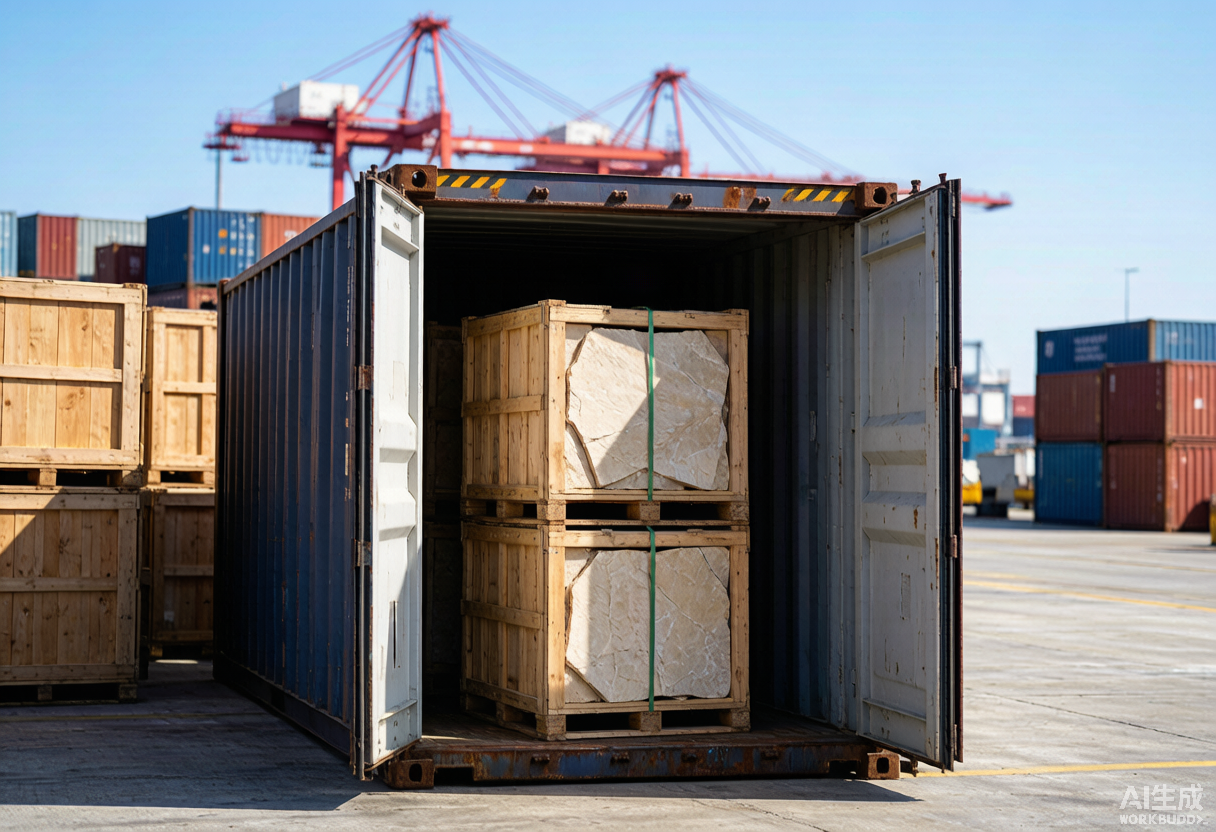
A 40-foot container of stone slabs at an international seaport — the final leg of most imports.
Step 1 — Define Your Specifications First
Before contacting any supplier, clarify:
- Stone type: granite, marble, quartz, limestone, slate, etc.
- Finish: polished, honed, flamed, brushed, leathered.
- Size & thickness: slabs, tiles, or cut-to-size (e.g., 600×600×20 mm).
- Application: flooring, countertops, exterior cladding, landscaping.
- Budget range: price drives quarry selection and processing.
The clearer your spec, the more accurate the quotation — and the less back-and-forth later.
Step 2 — Choose the Right Supplier Type
| Type | Pros | Cons | Best for |
|---|---|---|---|
| Direct factory | Best price; strong custom capability; bulk orders | May have slower quoting / limited English | Large, standardized projects |
| Trading company | Responsive; consolidates multiple factories; small orders | Slightly higher cost | Mixed-material or small projects |
| Quarry owner | Stable block quality for one color | Narrower range | Single-color, long-term supply |
Tip: Ask for a video call showing the production line. A real factory shows one facility from multiple angles; a trader shows inconsistent backgrounds.
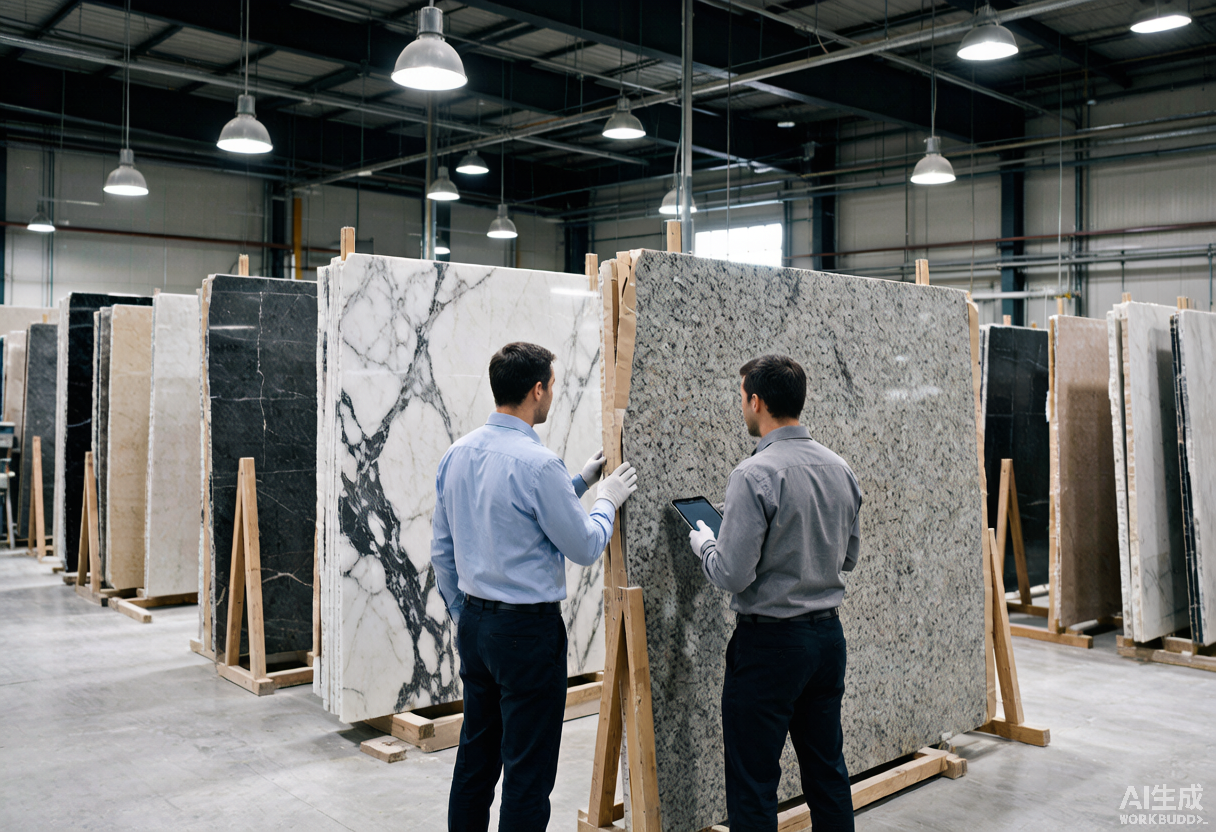
Inside a stone processing factory — ask suppliers for a video tour of the production line before committing.
Step 3 — Request a Detailed Quotation (Not Just a Price)
A reliable supplier provides a complete quote including:
- Stone origin and quarry name
- Grade / quality level
- Surface finish and processing details
- Packaging method (wooden crates, bundles, foam)
- Production lead time and MOQ
- Payment terms — industry norm is 30% deposit, 70% before shipment
Avoid suppliers who reply with a single price number and no explanation — it usually signals inexperience.
Step 4 — Validate with Samples & a Trial Order
Catalog photos mislead because natural stone varies. Request:
- Live videos of slabs/tiles; close-ups of grain and texture
- Comparisons across multiple bundles
- A small box of tiles, a sample slab section, or a trial of the first 100–200 m²
This confirms color tone, surface smoothness, and consistency before you commit to container-level volume.
Step 5 — Confirm Production & Lead Times
Typical China production windows (guide only):
| Product | Typical lead time |
|---|---|
| Tiles | 10–20 days |
| Cut-to-size | 15–30 days |
| Slabs | Usually in stock, immediate shipping |
| Countertops | 20–35 days |
Peak seasons (March–June, September–November) extend timelines. Plan ahead to protect your project schedule.
Step 6 — Inspection & Packaging Standards
Good packaging dramatically reduces breakage. Require:
- Strong ISPM-15 heat-treated wooden crates (non-negotiable — customs rejects non-compliant wood)
- Plastic film between tiles, foam/corner protectors, reinforced metal straps
- Clear labels and size markings; packaging photos before loading
For orders above ~$30,000, commission a third-party pre-shipment inspection (SGS, Bureau Veritas, or Intertek), typically $300–$800.
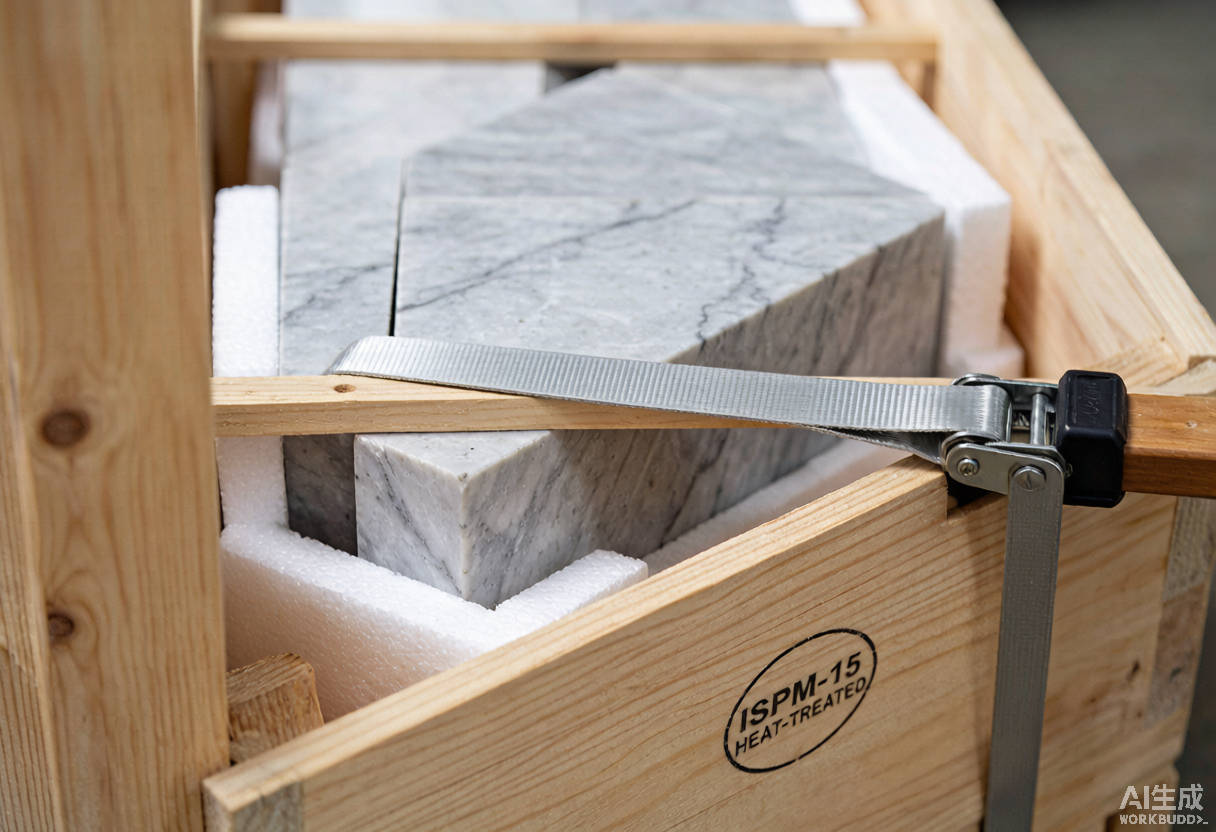
ISPM-15 heat-treated wooden crates with foam protection keep slabs intact in transit.
Step 7 — Shipping, Customs & Arrival Check
FCL vs LCL: Once you trust a supplier, book a Full Container Load (20′ or 40′). It is cheaper per m² and has lower breakage risk than Less-than-Container-Load. Most stone buyers prefer FCL.
Documents: commercial invoice, packing list, bill of lading, certificate of origin (CO / Form E where applicable), and quality/radiation reports if your country requires them.
On arrival: check color consistency, thickness tolerance, polish degree, cutting accuracy, breakage rate, and quantity vs packing list. Document issues immediately — reputable suppliers offer compensation per the agreed terms.
Understand Total Landed Cost (Not Just Factory Price)
The factory price is only about 50–65% of what you actually pay. Budget for the full chain:
Total Landed Cost = Factory Price + Inland Trucking + Export Customs + Ocean Freight + Marine Insurance + Import Duties & VAT + Destination Port Fees + Customs Broker + Last-Mile Trucking
A 20 ft container of mid-grade granite at a $15,000 factory price commonly lands at $22,000–$28,000 on a US East Coast warehouse floor. Run this math before negotiating, not after.
Red Flags When Choosing a Supplier
- Can’t provide batch-specific test reports or ISPM-15 packaging
- Demands 100% payment upfront (norm: 30% deposit / 70% before shipment)
- Refuses dry-lay photo review or video call
- Prices far below market (e.g., G654 at $12/m² when market is $25–45)
- No export history to your region
Frequently Asked Questions
What is a typical MOQ for Chinese stone?
Standard varieties often start around 20–30 pieces; custom sizes may require 50+ pieces. Confirm per supplier and per material.
How long does the whole import take?
From first inquiry to delivery: roughly 8–16 weeks, depending on order complexity, production, and ocean transit (14–40 days by route).
Do I need a freight forwarder?
Strongly recommended. A forwarder experienced in stone cargo handles customs clearance, insurance, and schedule updates — first-time buyers find it far easier.
How do I reduce breakage risk?
Book FCL (not LCL), require ISPM-15 export crating with foam and strapping, and request packaging photos before loading. Good packaging can push damage below 2%.
What certifications should I ask for?
ISO 9001, CE, and SGS test reports are common proof of quality systems and compliance. Request them during supplier vetting.
About the Source
STONELINK is a China-based natural stone manufacturer and exporter, supplying marble, granite, quartzite, and limestone in slabs, tiles, and cut-to-size formats to global importers, distributors, and project contractors. We support buyers with detailed quotations, batch photos, samples, and export-grade packaging. Full capabilities and project references are available on request.
This guide reflects common 2026 industry practices and is for planning only. Confirm all specifications, lead times, MOQ, pricing, and compliance with your chosen supplier and local import rules before ordering.
Explore Related Stone Products
- Cosmic Black granite kitchen countertops — bold, heat-resistant granite for kitchens
- Excalibur quartzite slab — marble look with granite-grade durability
- Raggio Verde green marble slab — rare green marble for countertops & feature walls
- Babylon Grey marble slab — elegant grey marble for floors & walls