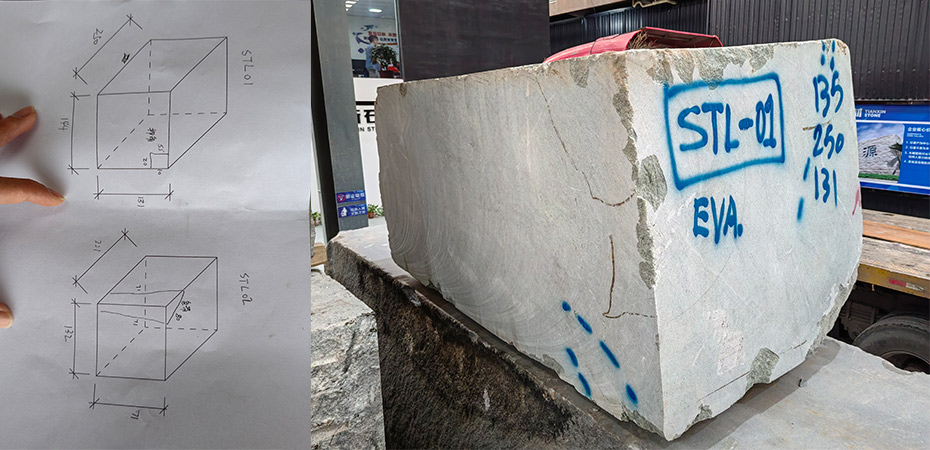
One cubic meter of granite weighs about 2.7 tonnes (2,700 kg).
Granite density runs 2.63–2.75 t/m³, so 1 m³ = 2.63–2.75 t depending on the block.
For estimating, multiply your volume in m³ by 2.7.
Granite Weight Conversion: m³ to Tonnes
| Volume | Approx. weight (at 2.7 t/m³) | Range (2.63–2.75 t/m³) |
|---|---|---|
| 0.5 m³ | 1.35 t | 1.31–1.38 t |
| 1 m³ | 2.70 t | 2.63–2.75 t |
| 2 m³ | 5.40 t | 5.26–5.50 t |
| 5 m³ | 13.50 t | 13.15–13.75 t |
| 10 m³ | 27.0 t | 26.3–27.5 t |
| 20 m³ | 54.0 t | 52.6–55.0 t |
Calculated from a granite density of 2.7 t/m³ (range 2.63–2.75 t/m³).
Actual weight varies with mineral composition and moisture content.
How to Work Out Slab Weight from Area and Thickness
Volume (m³) = area (m²) × thickness (m). Multiply by 2.7 to get tonnes.
- 20 mm slab: 0.02 × 2,700 kg/m³ = 54 kg per m² (0.054 t/m²)
- 30 mm slab: 0.03 × 2,700 kg/m³ = 81 kg per m² (0.081 t/m²)
- Example: 100 m² of 20 mm granite = 100 × 0.02 × 2.7 = 5.4 tonnes, before crating.
How Much Granite Fits in a 20ft Container?
Stone shipments are limited by road weight limits, not container volume. The usable payload of a
20ft container therefore depends on the truck and chassis rules at the destination — not on how much space is left.
| Destination | What the limit usually is | Net stone you can actually load |
|---|---|---|
| Europe, parts of South America & Africa | Trailer gross weight often capped at 24–26 t | 22–24 t |
| US inland points | Chassis + highway gross weight limits | 20–22 t |
| Middle East, Southeast Asia, Japan & Korea | Fewer road restrictions | 27–28 t |
At 2.7 t/m³ that means 22 t of granite is only about 8 m³ — roughly a
quarter of a 20ft container’s internal volume (≈33 m³). This is the mistake buyers make most often:
planning a stone shipment by volume and then being cut off by weight. Always confirm the road limit for your
delivery point before you book.
Related reading:
FCL vs LCL shipping for stone ·
Stone container shipping: loading and cost ·
Total landed cost of imported stone ·
Granite slabs: sizes and applications ·
How to buy stone slabs online
Granite Weight: Frequently Asked Questions
How many tonnes is 1 cubic meter of granite?
About 2.7 tonnes. Granite density ranges from 2.63 to 2.75 t/m³, so one cubic metre weighs 2.63–2.75 tonnes.
How do I convert square metres of granite to tonnes?
Multiply area by thickness in metres, then by 2.7. For 20 mm granite that is 0.054 t per m²; for 30 mm it is 0.081 t per m².
How many tonnes of granite fit in a 20ft container?
Typically 22–28 t of net stone, depending on destination: 22–24 t for Europe and parts of South America and
Africa (trailer gross limits of 24–26 t), 20–22 t for US inland points, and 27–28 t for the Middle East,
Southeast Asia, Japan and Korea. That is only about 8–10 m³ of stone — well under the container’s volume.
Does thickness or finish change the weight?
Thickness changes weight proportionally; polishing removes only a negligible amount. A 30 mm slab weighs about 50% more
per m² than a 20 mm slab.
Is marble the same weight as granite?
Both sit in a similar range, roughly 2.5–2.8 t/m³, so the same 2.7 working figure is normally used for estimating.
Confirm against the actual block before finalising a container plan.
Should I include crate weight?
Yes. The road limits above are gross weights, so wooden crates, bundles and dunnage eat into the stone payload.
Net stone = gross limit − crate weight.
Granite, as a common building material, is widely welcomed for its hardness, wear resistance, and beautiful appearance. When carrying out engineering construction or decoration, many people may encounter the question of “how many tons is one cubic meter of granite equal to?”. Today, I am here to answer this question for everyone.
Firstly, we need to understand the density of granite. Generally speaking, the density of granite ranges from 2.63 to 2.75 tons per cubic meter, which means that each cubic meter of granite weighs approximately 2630 to 2750 kilograms. Due to slight differences in the composition and structure of granite in different regions, the specific weight can be adjusted according to the actual situation.
So, how many tons is 1 cubic meter of granite equivalent to? Simply put, 1 cubic meter of granite is approximately equivalent to 2.63 to 2.75 tons, or 2.63 to 2.75 standard kilograms. This data is very important for engineering budgeting and material procurement, especially during large-scale construction. Mastering weight can help us accurately calculate transportation costs and equipment required for construction.
In addition, the density of granite with different specifications and processing methods may also vary. For example, granite that has been cut and polished may become slightly lighter due to the removal of some excess parts. Therefore, in practical applications, it is recommended to follow the specific product manual or consult with suppliers to obtain more accurate data.
In short, understanding the weight of granite can not only help us better select materials, but also improve the safety and economy of engineering projects. When choosing granite, in addition to focusing on price and appearance, remember to also consider its weight and corresponding transportation and construction requirements.
I hope this article can provide some practical information for friends who are currently renovating or constructing. If you have any other questions about granite, please feel free to send us an inquiry message and I will answer them immediately!
Frequently Asked Questions
How can I import natural stone from China?
Most overseas buyers work with Stonelink in four clear steps. (1) Share your project specifications, drawings or inspiration photos, or choose directly from our 60,000 m² inventory of 2,000+ designs. (2) We send whole-slab high-resolution photos and short video so you can verify exact veining, color and finish before committing — bookmatching and sequence are confirmed at this stage. (3) We handle export packing (foam-protected, fumigated wooden crates), container booking and ocean freight from Xiamen or Shuitou port. (4) Goods arrive at your destination port with the full document set (commercial invoice, packing list, Bill of Lading, certificate of origin, insurance). We support both full-container-load and LCL shipments, and all communication is in English.
What is your minimum order quantity (MOQ) and lead time?
MOQ typically starts from one container (about 20–27 tons depending on slab size and thickness), and mixed sizes or products are accepted so you can consolidate an entire project in one shipment. For smaller trials we can sometimes ship an LCL (less-than-container) batch of a few slabs, though the per-unit freight is higher; ask us and we will quote both options. Standard lead time is about 15–25 days after order confirmation for in-stock materials, or longer for custom cutting and special finishes. Before shipment we provide whole-slab photos and video so you know exactly what you receive, and we can hold stock for phased deliveries. For recurring orders we offer reserved inventory and rolling production schedules to keep your supply chain steady, and we quote both FOB Xiamen/Shuitou and delivered CIF or DDP to your port.
Can you send stone samples before I place an order?
Yes. We provide samples — offcuts or small slabs — so you can verify color, finish and quality before committing to a full shipment. Samples ship worldwide by courier (DHL, FedEx or UPS), typically within 3–7 days, and the sample cost is usually credited against your first container order. For large projects we can also send a full digital package — high-resolution whole-slab photos and short videos — so your designers can spec with confidence before any physical sample moves. Tell us the exact application, dimensions and finish you need and we will pick the most representative pieces rather than random offcuts, so the sample truly reflects the batch you would receive.
Do you provide quality control and certifications?
Yes. Stonelink is a China-based natural stone manufacturer and exporter operating from the Xiamen and Shuitou stone hub since 2012, with a 60,000 m² inventory spanning 2,000+ designs and direct quarry access, shipping to 80+ countries. Every shipment is inspected for packing and quality before loading — slabs are checked for cracks, bow, thickness tolerance and finish, then crated in foam-protected, fumigated wooden packaging. We can arrange third-party inspection (SGS, Intertek and similar) and supply the documentation your destination requires: commercial invoice, packing list, Bill of Lading, certificate of origin and, where relevant, CE marking or material test reports. Tell us your certification and labeling needs (for example the EU, US, Australia or Middle East) and we will match them and pre-clear the paperwork so customs clearance goes smoothly.
How do I choose the right natural stone for my project?
Start with the application: floors and high-traffic areas favor harder stones (granite, quartzite), while marble and onyx shine in lower-abuse, design-led spaces such as feature walls and vanities. Match the finish to the mood — polished for drama, honed for calm, leathered for texture — and confirm color stability under your actual lighting, since natural stone shifts with light. For wet areas choose a denser, well-sealing material and an appropriate finish, and review whole-slab photos or video with our team before you buy. We advise free of charge based on your project’s traffic, budget and aesthetic, so you avoid expensive mismatches and rework.
What shipping terms and documents are included?
We ship FOB Xiamen or Shuitou as standard and can also quote CIF or DDP to your port, so you control insurance and freight or let us handle it end to end. We manage export packing, container booking and ocean freight, and provide the full document set: commercial invoice, packing list, Bill of Lading, certificate of origin and cargo insurance. Both full-container-load and LCL (less-than-container-load) shipments are supported, and for landlocked destinations we can arrange door-to-door multimodal transport. Tell us your delivery address and incoterm preference and we will quote a landed cost, not just an ex-works price, so there are no surprises at the border.
Explore More Natural Stone
Quick answer
One cubic metre of granite weighs 2.63 to 2.75 tonnes, so a 20 mm slab weighs about 54 kg per square metre and a 30 mm slab about 81 kg per square metre. A 20 ft container normally carries 22 to 24 tonnes of stone, not the 27 to 28 tonnes its nominal payload suggests. Stonelink calculates slab counts and bundle weight before loading.
Source & specification
Stonelink (Xiamen Lianli Stone, established 2012) holds 60,000 m2 of slab inventory covering 2,000+ stone varieties and exports to 80+ countries. Buyers approve numbered photos of the actual slabs and a written specification before cutting, packing and container loading.
Next step:
Request a free quote ·
granite slabs and blocks ·
Browse 60,000 m2 of slab inventory ·
About Stonelink