

LOGISTICS & SHIPPING · Updated 2026 · For importers, wholesalers & project specifiers

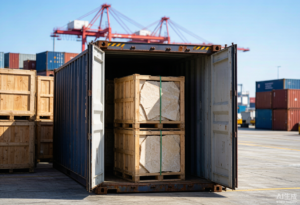
A full container of stone, properly crated and strapped — the lowest-risk way to move heavy, fragile material.
What FCL and LCL Mean for Stone
FCL (Full Container Load) means you book and fill an entire container — your stone is the only cargo inside. LCL (Less-than-Container Load) means your stone shares a container with other shippers’ goods, consolidated at origin and deconsolidated at destination. For natural stone, the difference is not just price — it is how many times your fragile, heavy slabs get moved.
Comparison Table
| Factor | FCL | LCL |
|---|---|---|
| Best order size | Full container (≈18–27 t, depending on stone) | Under ~8–10 m³ |
| Cost per ton | Lowest (fixed container rate split over volume) | High (charge by m³ or ton, whichever greater) |
| Handling touches | 1 pack + 1 unpack at destination | Multiple: consolidate, stuff, strip, deconsolidate |
| Breakage risk | Low (no co-load shifting, you control packing) | Higher (shared space, mixed cargo movement) |
| Transit time | Direct, faster | Slower (consolidation + deconsolidation delays) |
| Documentation | Simple, one B/L | More complex, shared B/L |
| Typical extra fees | Port/THC only | CFS, handling, AMS/ENS, docs per shipment |
Why Stone Favors FCL
- Weight economics: A 20ft container holds roughly 18–22 t of stone, a 40ft about 25–27 t. Spreading the fixed ocean freight across that volume makes FCL far cheaper per m² than LCL’s per-m³ charge.
- Breakage: Your crates are loaded once by your supplier and opened at your warehouse. No co-loaders shift against them, and no deconsolidation crew handles them mid-route.
- Control: You dictate crate spacing, bracing, and strapping. In LCL you cannot control how neighboring cargo is loaded.
When LCL Still Makes Sense
- Sample or trial orders under ~8 m³ where a full container is unjustified.
- Mixed small inventories for a showroom restock, not a project deadline.
- Testing a new supplier before committing to container-scale volume.
For a typical marble tile order, LCL can cost 40–70% more per unit than FCL once handling and CFS fees are added — and it adds 1–2 weeks. The “savings” of not filling a container are usually an illusion.
Reducing Breakage Risk Either Way
- Use ISPM-15 fumigated wooden crates with foam/plastic interleaving between slabs.
- Strap and brace crates so nothing shifts inside the container.
- Keep slabs upright (A-frame style) rather than stacked flat where possible.
- Add marine insurance (≈0.3–0.6% of cargo value) covering all-risk transit.
- Photograph loading and note any damage at unloading within the claim window.
How STONELINK Ships
STONELINK typically ships FCL for project and wholesale volumes, loading and bracing crates at our facility and sharing container-loading photos before departure. For smaller buyers, we can arrange LCL consolidation through trusted forwarders, with the same ISPM-15 crating standard. We recommend marine insurance on every shipment and provide packing lists and photos to support any transit claim.
Frequently Asked Questions
What volume makes FCL worth it for stone?
Roughly 8–10 m³ or more usually justifies a full container. Below that, LCL may be acceptable for trials, though per-unit cost and breakage risk both rise.
Why is breakage risk higher with LCL?
LCL cargo is consolidated with other shippers’ goods and handled multiple times — stuffing, stripping, deconsolidation. Each touch is a chance for fragile stone to crack or shift.
How much more does LCL cost than FCL?
Often 40–70% more per unit once CFS handling, documentation, and per-m³ ocean charges are included, plus 1–2 extra weeks of transit.
Should I insure stone shipments?
Yes. Marine insurance at about 0.3–0.6% of cargo value covering all-risk transit is inexpensive protection against the unavoidable hazards of ocean freight.
What does a 20ft vs 40ft container hold for stone?
A 20ft container typically carries 18–22 t of stone; a 40ft about 25–27 t, depending on density. Your supplier can confirm exact limits for your material.
About the Source
STONELINK is a natural stone manufacturer and exporter based in China, supplying marble, granite, quartzite, and other natural stone products to importers, wholesalers, and project contractors worldwide. For procurement support, samples, or a tailored quotation, contact our team.
This guide is educational. Always verify current export policies, shipping rates, and supplier credentials before placing orders.