
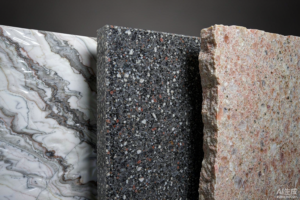
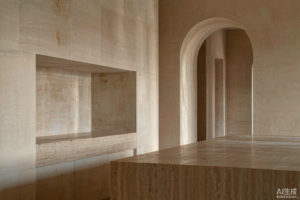
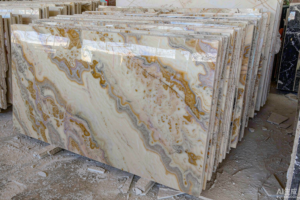
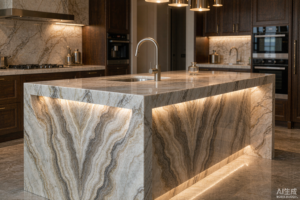
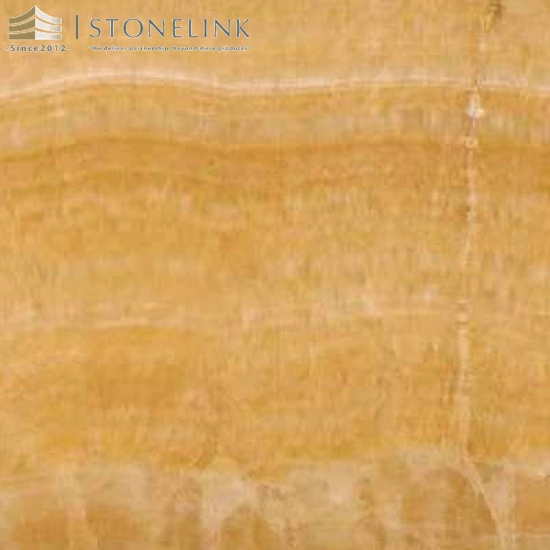
When a project needs a wall that stops people in their tracks, few materials deliver like backlit onyx and sodalite. Honey onyx brings warm, amber translucency; blue sodalite brings a deep, cobalt glow shot with white calcite veins. Both are translucent enough to transmit light, which is what turns a flat panel into a glowing centerpiece. This guide covers how each stone behaves under backlighting, how to specify them, and the practical limits importers should plan around before quoting a job.
Why Backlighting Changes Everything
Translucent stones look completely different lit from behind. In normal room light, honey onyx reads as a polished beige-gold stone. Add an LED panel behind a 20 mm slab and the amber bands start to glow, the depth in the stone becomes visible, and the surface feels lit from within. Blue sodalite does the same with cooler tones, the blue deepens and the white veining pops like cracks of light.
The effect depends on slab thickness and light uniformity. Thinner slabs (15–20 mm) transmit more light; thicker ones mute it. A well-built light box with even LED spacing matters more than raw brightness.
Honey Onyx: Warm and Versatile
Honey onyx is the more approachable of the two. Its palette, creams, ambers, and honey browns, sits comfortably in hospitality and residential interiors without feeling cold. It is a true onyx, a banded calcite, so it is softer than granite and needs care, but for vertical feature applications that is rarely a problem.
Typical uses:
- Backlit reception desks and bar fronts
- Vanity backsplashes in luxury bathrooms
- Partition panels and salon walls
- Small tabletops where the glow is a selling point
Stonelink stocks honey onyx among our 2,000+ designs and ships it from our Shuitou and Xiamen bases, usually as part of a mixed container with other exotic lines.
Blue Sodalite: The Statement Piece
Blue sodalite is rarer and bolder. The blue comes from the sodalite mineral itself, with white calcite and occasional grey veining cutting through. Under backlight it goes from a dark navy stone to an electric blue panel, which is why it shows up in high-end clubs, hotel lobbies, and signature restaurants rather than everyday homes.
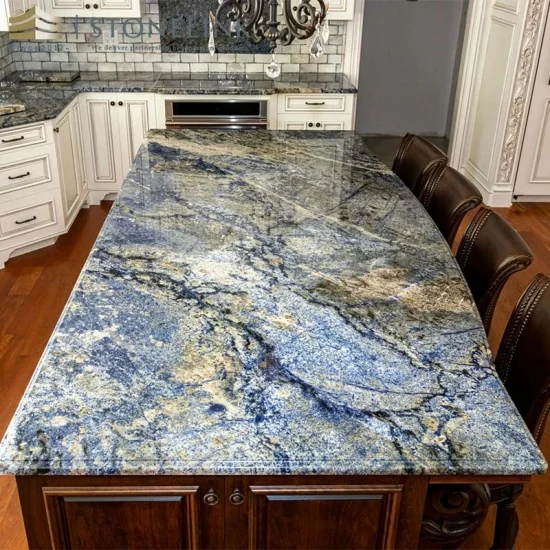
Two sourcing notes for buyers. First, true blue sodalite is distinct from sodalite-blue granite, which is an opaque granite that only looks blue in reflected light and does not backlight. Second, the blue intensity varies block to block, so if a client wants a specific saturation, request photos of the actual slab before loading.
Specifying Backlit Stone
To get a clean result, plan these details early:
- Thickness: 18–20 mm is standard for backlit panels. Go thinner only if the support structure allows.
- Reinforcement: onyx and sodalite are brittle. Large panels often need a backing of honeycomb aluminum or fiberglass to survive handling and transit.
- Light source: use diffused, even-temperature LEDs. Cold spots show through immediately on a glowing slab.
- Edge treatment: a polished or beveled edge reads cleaner than a raw one, and mitred edges hide the panel thickness.
Price Range and Lead Time
These are premium exotic stones, so budget accordingly. Industry range for honey onyx slabs runs roughly USD 60–140 per m² FOB China, while blue sodalite typically lands higher at around USD 120–300 per m² depending on blue saturation and slab size. Reinforcement and custom cut-to-size add to the final figure.
Because both are lower-volume lines, confirm current stock before committing a client. Our 60,000 m² inventory covers the full six stone families, but the most saturated sodalite blocks move fast across our 80+ export countries.
Frequently Asked Questions
Can honey onyx and blue sodalite be used on floors?
Not recommended. Both are soft, brittle calcite-based stones that scratch and chip under foot traffic, and floor installation makes backlighting impractical. Keep them vertical and protected.
Do I need a special fabricator?
Yes. Backlit installs need someone comfortable with translucent stone, edge mitering, and light-box construction. A standard granite countertop shop may not have the experience, so vet the fabricator before the slab ships.
How fragile are these slabs in shipping?
Onyx and sodalite crack more easily than granite, especially at thin gauges. We pack reinforced panels in A-frame crates with edge protection, and for large feature pieces we recommend honeycomb backing before transit.
Can I mix honey onyx and blue sodalite in one project?
Absolutely, and it is a strong combination: warm honey tones against cool blue makes each pop. We can consolidate both, plus other onyx or marble lines, into a single container from Xiamen.
Explore Our Stone Collection
Looking for the right slab for your project? Browse Stonelink’s inventory of 2,000+ designs across marble, granite, quartzite, travertine, onyx and limestone.
Ready to Source Honey Onyx & Blue Sodalite?
Contact the Stonelink team to review current slab photos, discuss reinforcement options, and price a backlit feature package. We source globally and ship from Shuitou and Xiamen to 80+ countries.
Frequently Asked Questions
How can I import natural stone from China?
Most overseas buyers work with Stonelink in four clear steps. (1) Share your project specifications, drawings or inspiration photos, or choose directly from our 60,000 m² inventory of 2,000+ designs. (2) We send whole-slab high-resolution photos and short video so you can verify exact veining, color and finish before committing — bookmatching and sequence are confirmed at this stage. (3) We handle export packing (foam-protected, fumigated wooden crates), container booking and ocean freight from Xiamen or Shuitou port. (4) Goods arrive at your destination port with the full document set (commercial invoice, packing list, Bill of Lading, certificate of origin, insurance). We support both full-container-load and LCL shipments, and all communication is in English.
What is your minimum order quantity (MOQ) and lead time?
MOQ typically starts from one container (about 20–27 tons depending on slab size and thickness), and mixed sizes or products are accepted so you can consolidate an entire project in one shipment. For smaller trials we can sometimes ship an LCL (less-than-container) batch of a few slabs, though the per-unit freight is higher; ask us and we will quote both options. Standard lead time is about 15–25 days after order confirmation for in-stock materials, or longer for custom cutting and special finishes. Before shipment we provide whole-slab photos and video so you know exactly what you receive, and we can hold stock for phased deliveries. For recurring orders we offer reserved inventory and rolling production schedules to keep your supply chain steady, and we quote both FOB Xiamen/Shuitou and delivered CIF or DDP to your port.
Can you send stone samples before I place an order?
Yes. We provide samples — offcuts or small slabs — so you can verify color, finish and quality before committing to a full shipment. Samples ship worldwide by courier (DHL, FedEx or UPS), typically within 3–7 days, and the sample cost is usually credited against your first container order. For large projects we can also send a full digital package — high-resolution whole-slab photos and short videos — so your designers can spec with confidence before any physical sample moves. Tell us the exact application, dimensions and finish you need and we will pick the most representative pieces rather than random offcuts, so the sample truly reflects the batch you would receive.
Do you provide quality control and certifications?
Yes. Stonelink is a China-based natural stone manufacturer and exporter operating from the Xiamen and Shuitou stone hub since 2012, with a 60,000 m² inventory spanning 2,000+ designs and direct quarry access, shipping to 80+ countries. Every shipment is inspected for packing and quality before loading — slabs are checked for cracks, bow, thickness tolerance and finish, then crated in foam-protected, fumigated wooden packaging. We can arrange third-party inspection (SGS, Intertek and similar) and supply the documentation your destination requires: commercial invoice, packing list, Bill of Lading, certificate of origin and, where relevant, CE marking or material test reports. Tell us your certification and labeling needs (for example the EU, US, Australia or Middle East) and we will match them and pre-clear the paperwork so customs clearance goes smoothly.
How do I choose the right natural stone for my project?
Start with the application: floors and high-traffic areas favor harder stones (granite, quartzite), while marble and onyx shine in lower-abuse, design-led spaces such as feature walls and vanities. Match the finish to the mood — polished for drama, honed for calm, leathered for texture — and confirm color stability under your actual lighting, since natural stone shifts with light. For wet areas choose a denser, well-sealing material and an appropriate finish, and review whole-slab photos or video with our team before you buy. We advise free of charge based on your project’s traffic, budget and aesthetic, so you avoid expensive mismatches and rework.
What shipping terms and documents are included?
We ship FOB Xiamen or Shuitou as standard and can also quote CIF or DDP to your port, so you control insurance and freight or let us handle it end to end. We manage export packing, container booking and ocean freight, and provide the full document set: commercial invoice, packing list, Bill of Lading, certificate of origin and cargo insurance. Both full-container-load and LCL (less-than-container-load) shipments are supported, and for landlocked destinations we can arrange door-to-door multimodal transport. Tell us your delivery address and incoterm preference and we will quote a landed cost, not just an ex-works price, so there are no surprises at the border.