
Choosing between honed and polished marble comes down to where the stone goes, how it gets used, and the look you want to land. Both finishes start from the same slab, but the surface treatment changes how the marble reads under light, how it wears day to day, and how much care it asks for after installation. If you are specifying for a client, stocking a slab yard, or importing containers, the finish decision affects not just the aesthetic but also yield, sealing, and the kind of after-sales questions you will field later.
At Stonelink we have shipped marble in both finishes to 80+ countries since 2012, out of our Shuitou & Xiamen bases, holding 60,000 m² of inventory across 2,000+ designs in six stone families. That volume means the same finish questions come up every week from importers and fabricators, so here is the practical breakdown rather than the marketing version.
What “Honed” and “Polished” Actually Mean
Polished marble is ground with progressively finer abrasives until the surface closes up and begins to reflect light. A good polish pushes the gloss reading to 80–90+ on a stone glossmeter and makes the background color and veining pop. Honed marble stops earlier, at a matte or low-satin stage. There is no reflective mirror, just a smooth, even, low-sheen face. The stone is still dense, but the surface pores sit slightly more open on a honed slab.
This single difference drives everything else. A polished face repels water and fingerprints a little better in the short term because the surface is tighter. A honed face feels warmer to the eye and hides minor surface variation, which is why many designers reach for it in large floor areas and matte-looking kitchens.
How the Two Finishes Read in a Finished Space
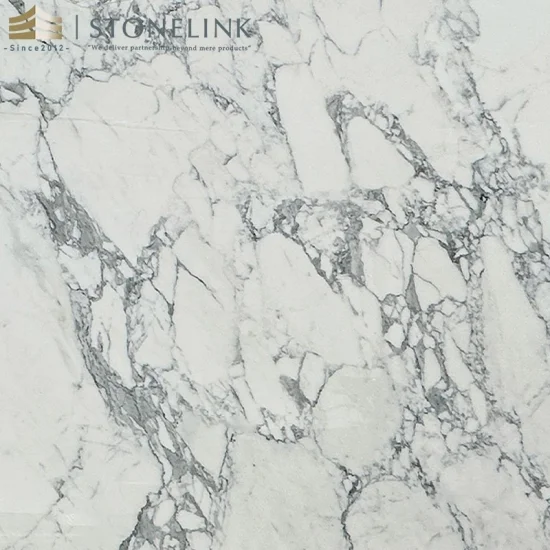
Polished marble reads brighter and more formal. Light bounces off the surface, so a white Calacatta or a soft beige looks more saturated and the veins look sharper. That is why polished marble dominates hotel lobbies, upscale bathrooms, and feature walls where drama is the point.
Honed marble reads softer and more natural. The lack of glare makes it a common choice for floors, stair treads, and backsplashes where you do not want a shiny reflection pulling focus. In a matte kitchen, a honed countertop sits quietly against wood and brushed metal.
Slip, Light and Maintenance
Honed is the safer pick for floors, especially in wet zones, because it does not throw glare and has a touch more tooth underfoot. Polished floors can get slick when wet, which is a real liability in entryways and bathrooms.
On the other hand, honed surfaces show etching (from lemon juice, wine, acidic cleaners) as dull spots more readily, because there is no gloss to hide the change. Polished marble shows etch marks too, but as lighter rough patches where the shine was knocked off. Both finishes need sealing; honed usually wants resealing a bit more often because the surface is more open.
For importers, the practical note is that sealing and maintenance guidance should ship with the stone. A container of honed marble heading to a humid market needs a different care sheet than a polished lot.
Which Finish Should You Choose?
A quick way to decide:
- Pick polished for vertical surfaces, feature walls, vanities, and anywhere you want maximum color and vein contrast.
- Pick honed for floors, staircases, outdoor-ish covered areas, and matte kitchen designs where glare is a problem.
- Pick polished if the client wants the easiest surface to wipe down and the boldest look.
- Pick honed if slip resistance and a natural, understated feel matter more than shine.
Sourcing Notes for Importers
The finish is applied at the fabrication stage, but slab selection still matters. Honed finish softens surface inconsistency, while polished magnifies every vein, fissure, and resin line. When you brief a supplier, be specific about which batches get which finish, because a book-matched polished job and a honed job from the same block will not look like the same stone.
With 60,000 m² of inventory and direct quarry access plus global sourcing, we can hold both finishes of the same material so a buyer can see the difference side by side before committing to a full container. That comparison alone settles most arguments on the showroom floor.
Frequently Asked Questions
Can you change a polished marble to honed later?
Yes, honing is a subtractive process, so a polished slab can be brought down to a honed finish on site. The reverse is not practical. If you are unsure, order polished and decide later, since going from honed back to polished means removing material you cannot put back.
Is honed marble more prone to staining?
Marginally, yes, because the surface is more open. With a proper penetrating sealer applied before installation and refreshed on a sensible schedule, the difference in real-world staining is small. The bigger risk is neglecting the sealer entirely.
Does the finish change the price much?
Finishing is a processing cost, not a material cost, so the gap is modest within industry range. Polished is slightly cheaper to produce at scale; specialty honed or leathered looks can add a little. The stone itself, block yield, and shipping move the price far more than the finish.
Which finish holds up better in a kitchen?
Both work. Polished shows etch marks as dull spots; honed shows them as lighter rough patches. Many homeowners actually prefer honed in kitchens because the wear looks more even and less obviously “damaged” than a scratched mirror finish.
Explore Our Stone Collection
Looking for the right slab for your project? Browse Stonelink’s inventory of 2,000+ designs across marble, granite, quartzite, travertine, onyx and limestone.
Ready to Source Marble?
Contact the Stonelink team to compare honed and polished slabs from the same block, or to request finish samples matched to your market. We ship from Shuitou & Xiamen to 80+ countries and hold 60,000 m² of marble inventory across 2,000+ designs.
Frequently Asked Questions
How can I import natural stone from China?
Most overseas buyers work with Stonelink in four clear steps. (1) Share your project specifications, drawings or inspiration photos, or choose directly from our 60,000 m² inventory of 2,000+ designs. (2) We send whole-slab high-resolution photos and short video so you can verify exact veining, color and finish before committing — bookmatching and sequence are confirmed at this stage. (3) We handle export packing (foam-protected, fumigated wooden crates), container booking and ocean freight from Xiamen or Shuitou port. (4) Goods arrive at your destination port with the full document set (commercial invoice, packing list, Bill of Lading, certificate of origin, insurance). We support both full-container-load and LCL shipments, and all communication is in English.
What is your minimum order quantity (MOQ) and lead time?
MOQ typically starts from one container (about 20–27 tons depending on slab size and thickness), and mixed sizes or products are accepted so you can consolidate an entire project in one shipment. For smaller trials we can sometimes ship an LCL (less-than-container) batch of a few slabs, though the per-unit freight is higher; ask us and we will quote both options. Standard lead time is about 15–25 days after order confirmation for in-stock materials, or longer for custom cutting and special finishes. Before shipment we provide whole-slab photos and video so you know exactly what you receive, and we can hold stock for phased deliveries. For recurring orders we offer reserved inventory and rolling production schedules to keep your supply chain steady, and we quote both FOB Xiamen/Shuitou and delivered CIF or DDP to your port.
Can you send stone samples before I place an order?
Yes. We provide samples — offcuts or small slabs — so you can verify color, finish and quality before committing to a full shipment. Samples ship worldwide by courier (DHL, FedEx or UPS), typically within 3–7 days, and the sample cost is usually credited against your first container order. For large projects we can also send a full digital package — high-resolution whole-slab photos and short videos — so your designers can spec with confidence before any physical sample moves. Tell us the exact application, dimensions and finish you need and we will pick the most representative pieces rather than random offcuts, so the sample truly reflects the batch you would receive.
Do you provide quality control and certifications?
Yes. Stonelink is a China-based natural stone manufacturer and exporter operating from the Xiamen and Shuitou stone hub since 2012, with a 60,000 m² inventory spanning 2,000+ designs and direct quarry access, shipping to 80+ countries. Every shipment is inspected for packing and quality before loading — slabs are checked for cracks, bow, thickness tolerance and finish, then crated in foam-protected, fumigated wooden packaging. We can arrange third-party inspection (SGS, Intertek and similar) and supply the documentation your destination requires: commercial invoice, packing list, Bill of Lading, certificate of origin and, where relevant, CE marking or material test reports. Tell us your certification and labeling needs (for example the EU, US, Australia or Middle East) and we will match them and pre-clear the paperwork so customs clearance goes smoothly.
How do I choose the right natural stone for my project?
Start with the application: floors and high-traffic areas favor harder stones (granite, quartzite), while marble and onyx shine in lower-abuse, design-led spaces such as feature walls and vanities. Match the finish to the mood — polished for drama, honed for calm, leathered for texture — and confirm color stability under your actual lighting, since natural stone shifts with light. For wet areas choose a denser, well-sealing material and an appropriate finish, and review whole-slab photos or video with our team before you buy. We advise free of charge based on your project’s traffic, budget and aesthetic, so you avoid expensive mismatches and rework.
What shipping terms and documents are included?
We ship FOB Xiamen or Shuitou as standard and can also quote CIF or DDP to your port, so you control insurance and freight or let us handle it end to end. We manage export packing, container booking and ocean freight, and provide the full document set: commercial invoice, packing list, Bill of Lading, certificate of origin and cargo insurance. Both full-container-load and LCL (less-than-container-load) shipments are supported, and for landlocked destinations we can arrange door-to-door multimodal transport. Tell us your delivery address and incoterm preference and we will quote a landed cost, not just an ex-works price, so there are no surprises at the border.