

RISK MANAGEMENT · Updated 2026 · For importers, wholesalers & project specifiers
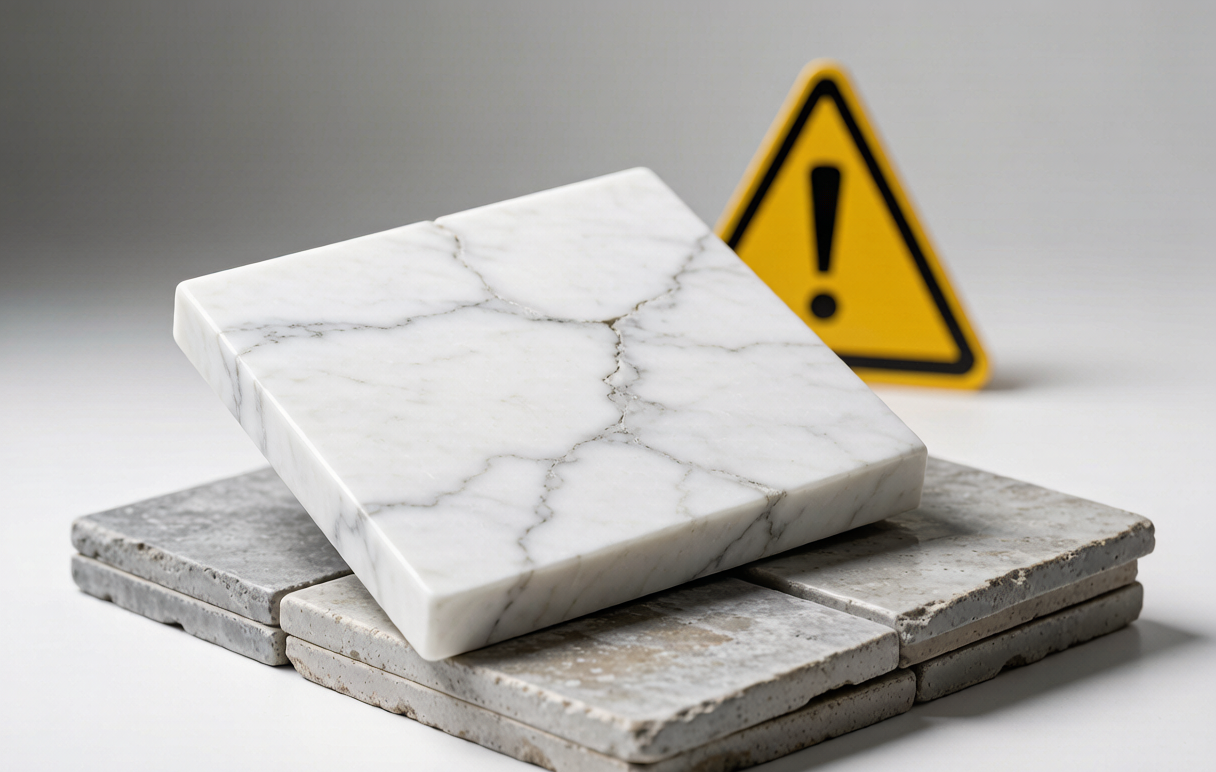
Low prices can hide real risks — cracked slabs, wrong color, or a supplier that disappears after deposit.
The Low-Price Trap
A quote 20–40% below the market average is rarely a bargain. In natural stone, below-market pricing usually means one of three things: lower-grade blocks, skipped QC, or a supplier planning to substitute material after you pay the deposit. The “savings” evaporate when a container arrives with cracks, color mismatch, or thickness out of tolerance — and rework or replacement costs far more than the original discount.
Top Red Flags, Ranked
| Red Flag | What It Usually Means | Risk Level |
|---|---|---|
| Price 20%+ below market | Substituted grade or skipped QC | High |
| No factory visit / video tour allowed | Possibly a shell, not a real factory | High |
| No real-spec sample offered | Capability or consistency gaps | Medium-High |
| Vague or no written contract | Disputes hard to enforce | High |
| Missing certifications (CE, SGS, ISPM-15) | Customs or quality exposure | Medium |
| Pushy 100% upfront / irreversible payment | Exit risk after deposit | Critical |
| Changing answers on MOQ/lead time | Disorganized or deceptive | Medium |
Digging Deeper Into the Warning Signs
1. Prices far below market
Ask for the exact block source and grade. A credible factory explains its pricing; a risky one dodges. Cross-check the quote against 2–3 other suppliers for the same spec.
2. No factory visit or live video
A genuine manufacturer can show you the line within minutes. Repeated excuses (“cameras broken,” “too busy”) are a strong signal the facility isn’t theirs.
3. No samples, or only generic offcuts
Samples should match your size, finish, and color. If they send an unrelated offcut, they may not be able to produce your actual order.
4. Vague contracts
Insist on a proforma invoice and contract specifying material, dimensions, finish, tolerance, quantity, price, Incoterms, and claim terms. “We’ll handle it” is not a contract.
5. Missing certifications
For destination markets, check CE marking (EU), SGS test reports, and ISPM-15 stamped crates. Missing docs can stall customs or fail project compliance.
6. Pushy payment terms
Standard is 30% deposit / 70% before shipment. Anyone rushing you to 100% via Western Union, crypto, or gift cards is a critical risk — stop immediately.
If a deal feels “too good to be true,” in stone it usually is. The cheapest CIF quote can become the most expensive mistake once breakage and rejects are counted.
How to Protect Yourself
- Verify the entity — business license, unified social credit code, export record.
- Commission a third-party inspection (SGS/TÜV) before the balance payment.
- Use secure payment — T/T with deposit/balance split, or LC at sight.
- Document everything in a signed contract with photos as attachments.
- Start small — a trial order proves the relationship before a full container.
How STONELINK Approaches Transparency
STONELINK’s quotes are tied to a stated block grade and finish, with in-house QC photos at each stage. We welcome factory video tours, third-party inspection, and paid real-spec samples, and we work on standard 30% deposit / 70% before shipment terms. Our crates are ISPM-15 compliant and our documentation is itemized — because a partner you can verify is a partner worth keeping.
Frequently Asked Questions
How much below market price is a real red flag?
A quote 20% or more below comparable suppliers for the same spec is a strong warning. It often signals grade substitution, skipped QC, or a post-deposit material swap.
Is refusing a factory visit always a bad sign?
Not every legitimate supplier allows on-site visits for scheduling or confidentiality reasons, but a live video tour of the line should always be possible. A refusal of both is a major red flag.
Which certifications matter for imported stone?
It depends on market: CE marking and SGS test reports are common for the EU; ISPM-15 stamped crates are required for wooden packaging in most countries. Confirm what your destination customs expects.
What payment terms are safe?
T/T with 30% deposit and 70% before shipment, or LC at sight, are standard and safe. Avoid 100% upfront, especially via irreversible methods like Western Union or crypto.
Can a third-party inspection really reduce risk?
Yes. An SGS or TÜV inspection before the balance payment verifies quantity, dimensions, finish, and packing — giving you leverage to reject or rework before money leaves your account.
About the Source
STONELINK is a natural stone manufacturer and exporter based in China, supplying marble, granite, quartzite, and other natural stone products to importers, wholesalers, and project contractors worldwide. For procurement support, samples, or a tailored quotation, contact our team.
This guide is educational. Always verify current export policies, shipping rates, and supplier credentials before placing orders.