
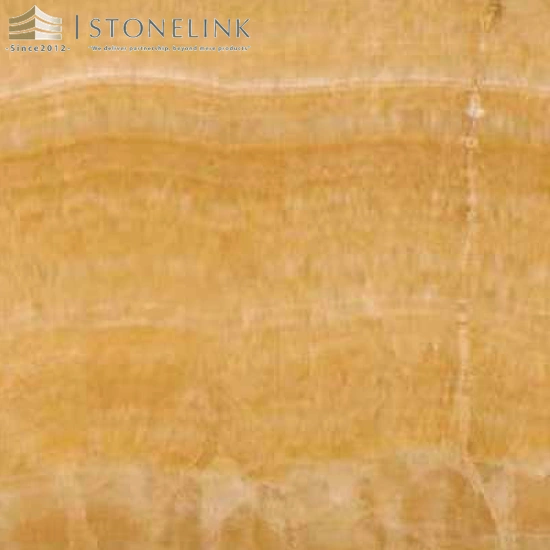
When a project needs a wall that stops people in their tracks, few materials deliver like backlit onyx and sodalite. Honey onyx brings warm, amber translucency; blue sodalite brings a deep, cobalt glow shot with white calcite veins. Both are translucent enough to transmit light, which is what turns a flat panel into a glowing centerpiece. This guide covers how each stone behaves under backlighting, how to specify them, and the practical limits importers should plan around before quoting a job.
Why Backlighting Changes Everything
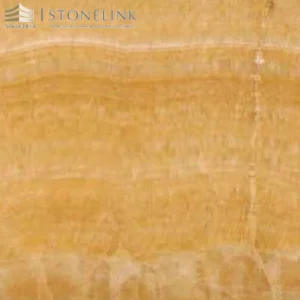
Translucent stones look completely different lit from behind. In normal room light, honey onyx reads as a polished beige-gold stone. Add an LED panel behind a 20 mm slab and the amber bands start to glow, the depth in the stone becomes visible, and the surface feels lit from within. Blue sodalite does the same with cooler tones, the blue deepens and the white veining pops like cracks of light.
The effect depends on slab thickness and light uniformity. Thinner slabs (15–20 mm) transmit more light; thicker ones mute it. A well-built light box with even LED spacing matters more than raw brightness.
Honey Onyx: Warm and Versatile
Honey onyx is the more approachable of the two. Its palette, creams, ambers, and honey browns, sits comfortably in hospitality and residential interiors without feeling cold. It is a true onyx, a banded calcite, so it is softer than granite and needs care, but for vertical feature applications that is rarely a problem.
Typical uses:
- Backlit reception desks and bar fronts
- Vanity backsplashes in luxury bathrooms
- Partition panels and salon walls
- Small tabletops where the glow is a selling point
Stonelink stocks honey onyx among our 2,000+ designs and ships it from our Shuitou and Xiamen bases, usually as part of a mixed container with other exotic lines.
Blue Sodalite: The Statement Piece
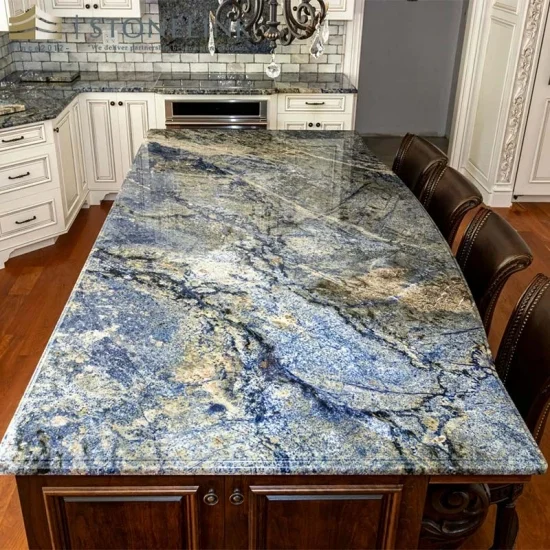
Blue sodalite is rarer and bolder. The blue comes from the sodalite mineral itself, with white calcite and occasional grey veining cutting through. Under backlight it goes from a dark navy stone to an electric blue panel, which is why it shows up in high-end clubs, hotel lobbies, and signature restaurants rather than everyday homes.
Two sourcing notes for buyers. First, true blue sodalite is distinct from sodalite-blue granite, which is an opaque granite that only looks blue in reflected light and does not backlight. Second, the blue intensity varies block to block, so if a client wants a specific saturation, request photos of the actual slab before loading.
Specifying Backlit Stone
To get a clean result, plan these details early:
- Thickness: 18–20 mm is standard for backlit panels. Go thinner only if the support structure allows.
- Reinforcement: onyx and sodalite are brittle. Large panels often need a backing of honeycomb aluminum or fiberglass to survive handling and transit.
- Light source: use diffused, even-temperature LEDs. Cold spots show through immediately on a glowing slab.
- Edge treatment: a polished or beveled edge reads cleaner than a raw one, and mitred edges hide the panel thickness.
Price Range and Lead Time
These are premium exotic stones, so budget accordingly. Industry range for honey onyx slabs runs roughly USD 60–140 per m² FOB China, while blue sodalite typically lands higher at around USD 120–300 per m² depending on blue saturation and slab size. Reinforcement and custom cut-to-size add to the final figure.
Because both are lower-volume lines, confirm current stock before committing a client. Our 60,000 m² inventory covers the full six stone families, but the most saturated sodalite blocks move fast across our 80+ export countries.
Frequently Asked Questions
Can honey onyx and blue sodalite be used on floors?
Not recommended. Both are soft, brittle calcite-based stones that scratch and chip under foot traffic, and floor installation makes backlighting impractical. Keep them vertical and protected.
Do I need a special fabricator?
Yes. Backlit installs need someone comfortable with translucent stone, edge mitering, and light-box construction. A standard granite countertop shop may not have the experience, so vet the fabricator before the slab ships.
How fragile are these slabs in shipping?
Onyx and sodalite crack more easily than granite, especially at thin gauges. We pack reinforced panels in A-frame crates with edge protection, and for large feature pieces we recommend honeycomb backing before transit.
Can I mix honey onyx and blue sodalite in one project?
Absolutely, and it is a strong combination: warm honey tones against cool blue makes each pop. We can consolidate both, plus other onyx or marble lines, into a single container from Xiamen.
Explore Our Stone Collection
Looking for the right slab for your project? Browse Stonelink’s inventory of 2,000+ designs across marble, granite, quartzite, travertine, onyx and limestone.
Ready to Source Honey Onyx & Blue Sodalite?
Contact the Stonelink team to review current slab photos, discuss reinforcement options, and price a backlit feature package. We source globally and ship from Shuitou and Xiamen to 80+ countries.