

A marble staircase is a statement of permanence and taste, whether it sweeps through a villa foyer or climbs a garden terrace. But stairs are also the most safety-critical surface in any building, and stone that is beautiful yet slippery is a liability. The good news is that with the right finish, profile, and detailing, marble stairs are both gorgeous and safe. This guide covers slip resistance, structure, veining layout, maintenance, and when granite is the better call for heavy traffic.
Why Specify Marble Stairs?
Marble steps deliver a continuous, seamless elegance that carpet or timber cannot match. They suit grand interiors, luxury bathrooms, and refined exterior entries. Because marble can be honed, flamed, or fitted with anti-slip strips, it is entirely possible to make a marble staircase safe without sacrificing looks. The stone is also dimensionally stable and, once installed, remarkably long-lived.
The only real limitation is hardness: at 3–4 on the Mohs scale, marble scratches more easily than granite, so in very high-traffic commercial stairs granite often wins. For homes and moderate-traffic areas, marble is a superb choice.
Slip Resistance: The Non-Negotiable
A polished marble step is dangerous when wet, full stop. For any stair that could see moisture, rain, or bare feet, you must choose a textured finish. The main options are:
Honed — a matte surface with mild grip, fine for dry indoor stairs. Flamed — a torch-treated rough face with strong traction, ideal for exterior steps. Sandblasted — an even non-slip tooth. Anti-slip strips or inserts — brass, stainless, or carved grooves set into the tread nose for extra security on otherwise smooth stone. For exterior marble stairs or pool-adjacent steps, pair a honed or flamed finish with a contrasting nosing strip so the edge is visible and grippy.
Tread, Riser, and Nosing Detail
Good stair design starts with proportion. Keep tread depth and riser height consistent, follow local building codes, and give the nosing (the front edge of the tread) a profile that is safe and looks intentional. A half-bullnose or pencil-edge nosing softens the corner and resists chipping better than a crisp 90° edge. For a modern look, a matching marble baseboard and stringer keep the stone theme continuous.
Visibility matters for safety: a contrasting strip or a slightly lighter nosing helps the eye read each step. In low-light areas, consider a subtle LED strip recessed into the stringer rather than relying on the stone alone.
Thickness and Structural Support
Marble treads are typically 3 cm or thicker, and for a floating or cantilevered stair they may be laminated to 4–6 cm for rigidity. The stone must sit on a solid substrate or structural support; marble is strong in compression but can crack if it spans too far with only edge support. Your fabricator should calculate support spacing and use colour-matched adhesive so the joints disappear. For exterior steps, ensure the base drains and that no water is trapped under the tread.
Veining Layout and Bookmatching
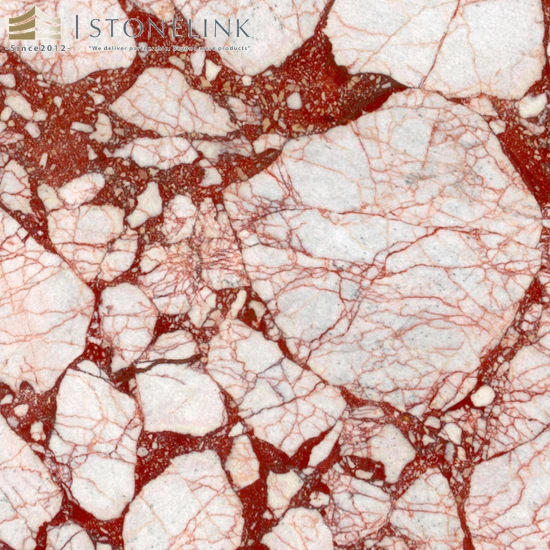
On stairs, veining direction controls the result. A running match carries the pattern smoothly along the run so the eye flows down the flight. A bookmatch on a feature stair mirrors the veining across each tread or along a curved wall for drama. For a calm, uniform look, select slabs with consistent background tone and request that the fabricator lays out the sequence before cutting so the grain reads deliberately rather than randomly.
Marble vs Granite for Stairs
This is the key decision for busy stairs. Granite scores 6–7 on the Mohs scale, shrugs off scratches, and holds a flamed non-slip finish for decades, so it is the workhorse for shopping centres, transit stairs, and any high-traffic commercial run. Marble is softer and more prone to wear at the nosing, but it is unbeatable for residential elegance and low-traffic feature stairs. A pragmatic hybrid: marble for the show staircase in a home, granite for the back stair or a commercial building. Stonelink, exporting from Xiamen and Shuitou since 2012 with 60,000 m² of inventory and 2,000+ designs shipped to 80+ countries, can supply both from direct quarry access so you can mix materials within one project.
Maintenance of Marble Steps
Care is straightforward but matters for safety. Sweep or dust-mop regularly so grit does not abrade the surface or act as a slip layer. Clean with a pH-neutral product and never vinegar or acidic cleaners, which etch marble. Reseal honed indoor stairs every year or two and exterior steps more often, since weathering and foot traffic open the pores. Check anti-slip strips and nosing for wear and replace them before they fail. Promptly wipe any spill, especially on a polished area.
Specifying Marble Stairs: Checklist
Confirm finish (honed for dry indoor, flamed or stripped for wet/exterior), tread thickness and support, nosing profile, veining layout, and a sealing plan. Ask for slab photos of the actual batches so the run is consistent. Good detailing up front is what separates a safe, handsome marble staircase from a regret.
Curved and Feature Staircases
Marble truly shows off on curved or helical stairs, where each tread is a custom wedge and the continuous veining flowing around the turn becomes sculpture. These are specialist fabrications: the wedge treads must be cut with precision, the inner and outer nosing radiused consistently, and the supporting steel or concrete structure built to tight tolerances. Budget more time and money than for straight runs, and insist on a full-scale template before any stone is cut. A curved marble stair is a once-in-a-building decision, so the craftsmanship of both the carpenter and the stonemason is what delivers the result.
Interior vs Exterior Stair Detailing
Interior marble stairs live in a controlled climate, so a honed finish with discreet anti-slip strips is usually enough, and sealing can be lighter. Exterior marble steps face rain, algae, and freeze-thaw, so specify a flamed or sandblasted finish, a visible nosing, and more frequent resealing; in cold regions, seriously consider granite instead. Lighting differs too: interior stairs can rely on ambient room light, while exterior steps need dedicated, glare-free illumination so the edge is always readable at night. Designing the stair for its actual environment prevents both accidents and premature wear.
Cost and Value Considerations
Marble stairs cost more than carpet or timber and roughly align with good granite, varying by marble variety and the amount of custom cutting. The value is longevity and looks: a well-built marble stair does not need replacing, only occasional restoration, and it lifts the perceived quality of the whole property. To control cost, keep the geometry simple where you can, standardise tread sizes, and choose a marble with consistent background tone so offcuts can be used efficiently. As with every stone project, reserving matched slabs up front avoids the expense of a colour mismatch later.
Restoration and Repair Over Time
One of marble’s quiet advantages is that it can be renewed rather than replaced. A worn or etched tread can be honed and re-polished in place by a stone restorer, and small chips at the nosing can be filled with colour-matched resin and buffed flush. For exterior stairs, reset any lifted treads promptly so water does not get under neighbours and cause wider failure. Keep a few spare matched treads from the original attic stock for a like-for-like swap if a step is ever badly damaged. With this simple plan, a marble staircase stays safe and handsome for the life of the building, needing only periodic attention rather than full replacement.
Frequently Asked Questions
Are marble stairs slippery?
Polished marble stairs are slippery when wet, but a honed, flamed, or sandblasted finish with anti-slip strips is safe. Always choose a textured finish for any stair that could get wet or sees bare feet.
How thick should marble stair treads be?
Typically 3 cm, or laminated to 4–6 cm for floating or cantilevered designs. The tread must be fully supported on a solid substrate so it cannot crack under load.
Is granite better than marble for stairs?
For high-traffic or commercial stairs, yes: granite is harder, scratch-resistant, and holds a non-slip flamed finish far longer. Marble is the premium choice for residential and low-traffic feature stairs where appearance leads.
Do marble steps need sealing?
Yes. Honed indoor steps every year or two, exterior steps more often due to weather and traffic. Reseal when water stops beading, and keep anti-slip strips in good condition.
Explore Our Stone Collection
Looking for the right slab for your project? Browse Stonelink’s inventory of 2,000+ designs across marble, granite, quartzite, travertine, onyx and limestone.
Ready to Source Marble for Your Project?
Contact the Stonelink team to compare slabs from our 60,000 m² inventory and get an export quote for your next project.
Frequently Asked Questions
How can I import natural stone from China?
Most overseas buyers work with Stonelink in four clear steps. (1) Share your project specifications, drawings or inspiration photos, or choose directly from our 60,000 m² inventory of 2,000+ designs. (2) We send whole-slab high-resolution photos and short video so you can verify exact veining, color and finish before committing — bookmatching and sequence are confirmed at this stage. (3) We handle export packing (foam-protected, fumigated wooden crates), container booking and ocean freight from Xiamen or Shuitou port. (4) Goods arrive at your destination port with the full document set (commercial invoice, packing list, Bill of Lading, certificate of origin, insurance). We support both full-container-load and LCL shipments, and all communication is in English.
What is your minimum order quantity (MOQ) and lead time?
MOQ typically starts from one container (about 20–27 tons depending on slab size and thickness), and mixed sizes or products are accepted so you can consolidate an entire project in one shipment. For smaller trials we can sometimes ship an LCL (less-than-container) batch of a few slabs, though the per-unit freight is higher; ask us and we will quote both options. Standard lead time is about 15–25 days after order confirmation for in-stock materials, or longer for custom cutting and special finishes. Before shipment we provide whole-slab photos and video so you know exactly what you receive, and we can hold stock for phased deliveries. For recurring orders we offer reserved inventory and rolling production schedules to keep your supply chain steady, and we quote both FOB Xiamen/Shuitou and delivered CIF or DDP to your port.
Can you send stone samples before I place an order?
Yes. We provide samples — offcuts or small slabs — so you can verify color, finish and quality before committing to a full shipment. Samples ship worldwide by courier (DHL, FedEx or UPS), typically within 3–7 days, and the sample cost is usually credited against your first container order. For large projects we can also send a full digital package — high-resolution whole-slab photos and short videos — so your designers can spec with confidence before any physical sample moves. Tell us the exact application, dimensions and finish you need and we will pick the most representative pieces rather than random offcuts, so the sample truly reflects the batch you would receive.
Do you provide quality control and certifications?
Yes. Stonelink is a China-based natural stone manufacturer and exporter operating from the Xiamen and Shuitou stone hub since 2012, with a 60,000 m² inventory spanning 2,000+ designs and direct quarry access, shipping to 80+ countries. Every shipment is inspected for packing and quality before loading — slabs are checked for cracks, bow, thickness tolerance and finish, then crated in foam-protected, fumigated wooden packaging. We can arrange third-party inspection (SGS, Intertek and similar) and supply the documentation your destination requires: commercial invoice, packing list, Bill of Lading, certificate of origin and, where relevant, CE marking or material test reports. Tell us your certification and labeling needs (for example the EU, US, Australia or Middle East) and we will match them and pre-clear the paperwork so customs clearance goes smoothly.
How do I choose the right natural stone for my project?
Start with the application: floors and high-traffic areas favor harder stones (granite, quartzite), while marble and onyx shine in lower-abuse, design-led spaces such as feature walls and vanities. Match the finish to the mood — polished for drama, honed for calm, leathered for texture — and confirm color stability under your actual lighting, since natural stone shifts with light. For wet areas choose a denser, well-sealing material and an appropriate finish, and review whole-slab photos or video with our team before you buy. We advise free of charge based on your project’s traffic, budget and aesthetic, so you avoid expensive mismatches and rework.
What shipping terms and documents are included?
We ship FOB Xiamen or Shuitou as standard and can also quote CIF or DDP to your port, so you control insurance and freight or let us handle it end to end. We manage export packing, container booking and ocean freight, and provide the full document set: commercial invoice, packing list, Bill of Lading, certificate of origin and cargo insurance. Both full-container-load and LCL (less-than-container-load) shipments are supported, and for landlocked destinations we can arrange door-to-door multimodal transport. Tell us your delivery address and incoterm preference and we will quote a landed cost, not just an ex-works price, so there are no surprises at the border.