
STONE FINISHES · Updated 2026 · For importers, fabricators, contractors & specifiers
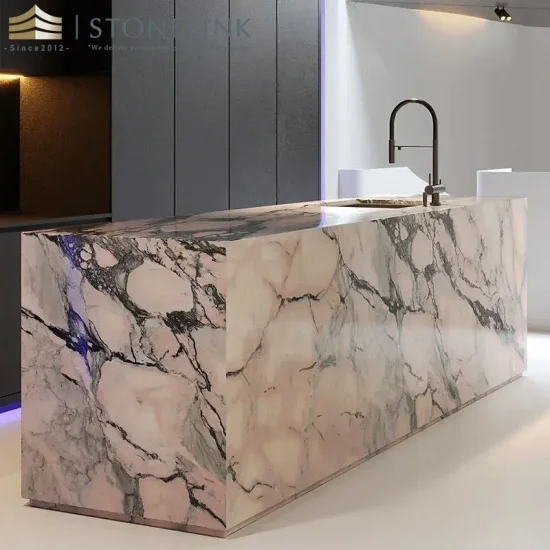
The same marble can read completely different depending on whether it is polished, honed, or leathered.
A slab’s finish changes how the stone looks, feels, and performs — often more than the stone variety itself. Specifiers sometimes default to polished without considering the room. Here is how the three main finishes compare on marble, granite, and quartzite alike.
Polished Finish
Achieved by progressive diamond grinding to a reflective, non-porous-looking surface. It maximizes color depth and vein contrast.
- Look: High-gloss, mirror-like; veins “pop.”
- Slip resistance: Lowest (slippery when wet) — avoid for floors and pool copings.
- Maintenance: Most stain-resistant because pores are closed, but etch marks are most visible against the gloss.
- Best for: Feature walls, vanities, low-traffic indoor tops, backsplashes.
Honed Finish
Ground to a smooth, flat matte surface with little to no sheen. The stone reads softer and warmer.
- Look: Matte, chalky-elegant; veins subdued.
- Slip resistance: Moderate — safer than polished for light floor use.
- Maintenance: More porous, so it stains and etches more readily; but etch dullness blends into the matte look and is far less noticeable.
- Best for: Busy kitchens, bathrooms, floors where you want to hide wear.
Leathered Finish
Created by brushing the honed surface with abrasive diamonds and then a texturing pass, leaving a soft, slightly bumpy “leather” feel with low sheen.
- Look: Dimensional, low-luster, tactile; enhances movement in the stone.
- Slip resistance: Highest of the three — good for floors and wet areas.
- Maintenance: Textured pores can trap residue, so cleaning needs a soft brush; resists etching visually better than polished.
- Best for: Outdoor kitchens, rustic/modern interiors, floors, and anywhere grip matters.
Comparison Table
| Attribute | Polished | Honed | Leathered |
|---|---|---|---|
| Sheen | Mirror gloss | Matte | Low, textured |
| Vein contrast | Maximum | Softened | Enhanced dimension |
| Slip resistance | Low | Medium | High |
| Stain resistance | High (pores closed) | Lower | Medium |
| Etch visibility | Very visible | Camouflaged | Camouflaged |
| Cleaning effort | Easy | Easy | Needs soft brush |
| Typical use | Walls, vanities | Kitchens, baths | Floors, outdoors |
Choosing By Application
| Project area | Recommended finish | Why |
|---|---|---|
| Kitchen island (showpiece) | Polished or honed | Polished for drama; honed to hide etching |
| Busy family kitchen | Honed | Etch marks disappear into matte |
| Bathroom floor | Honed or leathered | Better slip resistance when wet |
| Outdoor kitchen | Leathered | Grip + hides weathering |
| Feature wall / fireplace | Polished | Maximizes depth and light reflection |
Rule of thumb: the glossier the finish, the more it shows every etch and water spot. If your client hates seeing wear, step down to honed or leathered.
STONELINK offers polished, honed, and leathered finishes across its marble, granite, and quartzite ranges and can finish a sample board so specifiers can compare the three side by side before ordering a full container.
Frequently Asked Questions
Can any stone be leathered, or only marble?
Leathering works on most stones but shows best on those with movement and harder minerals. It is common on marble, granite, and quartzite; very uniform stones show little effect.
Does honed marble stain more than polished?
Yes. Honed surfaces keep more open pores, so they absorb spills faster. Sealing every 6–12 months is important, and wiping spills promptly prevents most stains.
Is polished marble slippery?
Polished stone is the slickest finish, especially when wet, so it is not advised for floors, showers, or pool edges. Use honed or leathered there.
Can I change the finish later?
Often yes — a professional restorer can hone a polished top or re-leather a surface, though going from honed back to high polish requires material removal and may not restore original depth. Plan the finish up front.
Which finish best hides etching?
Honed and leathered both camouflage etch dullness well because they lack gloss. Polished makes etch marks obvious. For acid-prone kitchens, choose honed or leathered.
About the Source
STONELINK is a natural stone manufacturer and exporter supplying marble, granite, quartzite, and other natural stone slabs, tiles, and cut-to-size pieces to importers, wholesalers, and project contractors worldwide. For material selection support or a tailored quotation, contact our team.
This guide is educational. Always request current batch photos, samples, and a written quotation before ordering.