KITCHEN SURFACES · Updated 2026 · For importers, fabricators, contractors & specifiers
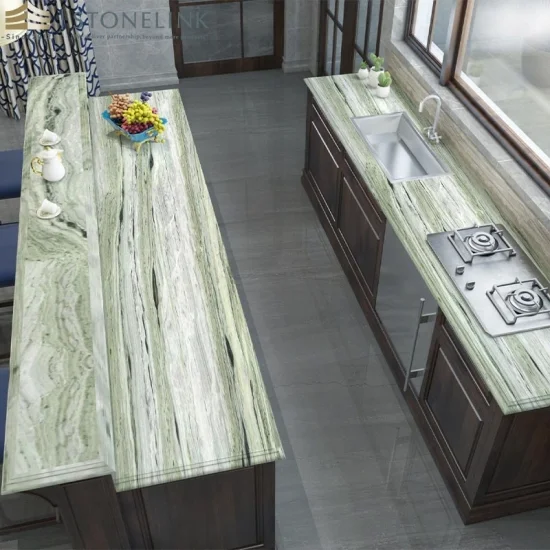
A polished marble countertop — beautiful, but it requires a realistic understanding of etching and sealing before specification.
Marble has topped kitchens for centuries — from Roman villas to Parisian pâtisseries. The debate “is marble good for kitchens?” is really a question of expectations. If you want a counter that looks factory-new forever, marble will disappoint. If you want a surface that ages with character, few materials compete.
The Honest Pros
- Heat resistance: Marble tolerates hot pots far better than engineered quartz (which can scorch above ~150 °C / 300 °F). You can set a warm pan down — though trivets are still wise.
- Natural coolth: At ~2.7 g/cm³ density and high thermal mass, marble stays cool, which is why bakers love it for pastry and dough.
- Timeless look: No engineered surface replicates the depth and veining of natural stone.
- Repairable: Etching and light scratches can be honed or re-polished in place by a stone restorer.
The Honest Cons
- Etching: Calcite (Mohs ~3) reacts with acids — lemon, vinegar, wine, tomato — leaving dull spots. This is chemical, not staining, and cannot be wiped away.
- Scratching: Softer than granite (Mohs 6–7) and quartzite (Mohs 7); knives and abrasive grit leave marks.
- Staining if unsealed: Marble is moderately porous; unsealed tops absorb oil and pigment.
- Maintenance discipline: Requires periodic sealing and immediate cleanup of acids.
Understanding Etching vs Staining
These are different problems with different fixes:
| Issue | Cause | Appearance | Fix |
|---|---|---|---|
| Etch mark | Acid reacts with calcite | Dull, lighter rough spot | Honing / re-polishing |
| Stain | Oil, wine, pigment in pores | Darkened discolored patch | Poultice + sealing |
| Scratch | Abrasion (knife, grit) | Visible line/groove | Honing / polishing |
Sealing: The Real Schedule
Most marble kitchen tops need a penetrating sealer re-applied every 6–12 months, depending on use and the product. A simple “water test” tells you when: if water beads, the seal holds; if it darkens the stone within a few minutes, it is time to reseal. Honed finishes absorb more than polished, so they may need sealing slightly more often.
The “marble is high-maintenance” reputation is overstated. A 10-minute reseal twice a year and wiping acid spills promptly is the entire routine for most households.
Marble vs Granite vs Quartzite
| Property | Marble | Granite | Quartzite |
|---|---|---|---|
| Mohs hardness | ~3 | 6–7 | 7 |
| Etching from acid | Yes (calcite) | No (silicate) | Minimal |
| Heat resistance | Excellent | Excellent | Excellent |
| Stain resistance (sealed) | Moderate | High | High |
| Look | Soft veined elegance | Speckled/variegated | Marble-like, harder |
| Best for | Bakers, low-traffic, patina lovers | Busy family kitchens | Marble look + durability |
Who Should Choose Marble — and Who Shouldn’t
Choose marble if: you bake often, you like a living surface that develops patina, the kitchen is light-duty or a showpiece, and you are comfortable with a simple sealing routine.
Avoid marble if: the kitchen is a heavy-cooking, acidic-sauce household with children who leave spills, you want a zero-maintenance top, or the surface must stay showroom-perfect for resale photography.
STONELINK provides both marble and harder alternatives like granite and quartzite, and can supply honed or leathered marble finishes that disguise light etching better than high-polish surfaces — a smart compromise for busy kitchens.
Frequently Asked Questions
Will a marble countertop stain easily?
Not if sealed. Sealed marble resists most stains, but it etches (dulls) on acid contact — lemon, vinegar, wine — which is different from staining. Reseal every 6–12 months and wipe acids promptly.
Can I cut directly on marble?
Technically yes, but you will scratch it (Mohs ~3) and dull your knives. Always use a cutting board. Light scratches can be honed out by a stone restorer.
Does marble crack from heat?
No. Marble handles hot cookware well — far better than engineered quartz, which can scorch above ~150 °C. Sudden extreme thermal shock (e.g., liquid nitrogen) is the exception, not kitchen reality.
Is honed marble better than polished for kitchens?
For busy kitchens, often yes. Honed finishes hide etching and light scratches better than mirror polish, though they are slightly more porous and may need sealing a little more often.
How much does marble kitchen countertop cost?
Indicative uninstalled slab pricing runs roughly $40–$400+/sq ft depending on variety (Carrara at the low end, Calacatta/Statuario at the high end), plus fabrication and freight. Request a written quote per project.
About the Source
STONELINK is a natural stone manufacturer and exporter supplying marble, granite, quartzite, and other natural stone slabs, tiles, and cut-to-size pieces to importers, wholesalers, and project contractors worldwide. For material selection support or a tailored quotation, contact our team.
This guide is educational. Always request current batch photos, samples, and a written quotation before ordering.
Looking for a marble supplier in China? Stonelink supplies marble slabs and cut-to-size from Shuitou, China to 80+ countries — explore our full marble program.
Frequently Asked Questions
How can I import natural stone from China?
Most overseas buyers work with Stonelink in four clear steps. (1) Share your project specifications, drawings or inspiration photos, or choose directly from our 60,000 m² inventory of 2,000+ designs. (2) We send whole-slab high-resolution photos and short video so you can verify exact veining, color and finish before committing — bookmatching and sequence are confirmed at this stage. (3) We handle export packing (foam-protected, fumigated wooden crates), container booking and ocean freight from Xiamen or Shuitou port. (4) Goods arrive at your destination port with the full document set (commercial invoice, packing list, Bill of Lading, certificate of origin, insurance). We support both full-container-load and LCL shipments, and all communication is in English.
What is your minimum order quantity (MOQ) and lead time?
MOQ typically starts from one container (about 20–27 tons depending on slab size and thickness), and mixed sizes or products are accepted so you can consolidate an entire project in one shipment. For smaller trials we can sometimes ship an LCL (less-than-container) batch of a few slabs, though the per-unit freight is higher; ask us and we will quote both options. Standard lead time is about 15–25 days after order confirmation for in-stock materials, or longer for custom cutting and special finishes. Before shipment we provide whole-slab photos and video so you know exactly what you receive, and we can hold stock for phased deliveries. For recurring orders we offer reserved inventory and rolling production schedules to keep your supply chain steady, and we quote both FOB Xiamen/Shuitou and delivered CIF or DDP to your port.
Can you send stone samples before I place an order?
Yes. We provide samples — offcuts or small slabs — so you can verify color, finish and quality before committing to a full shipment. Samples ship worldwide by courier (DHL, FedEx or UPS), typically within 3–7 days, and the sample cost is usually credited against your first container order. For large projects we can also send a full digital package — high-resolution whole-slab photos and short videos — so your designers can spec with confidence before any physical sample moves. Tell us the exact application, dimensions and finish you need and we will pick the most representative pieces rather than random offcuts, so the sample truly reflects the batch you would receive.
Do you provide quality control and certifications?
Yes. Stonelink is a China-based natural stone manufacturer and exporter operating from the Xiamen and Shuitou stone hub since 2012, with a 60,000 m² inventory spanning 2,000+ designs and direct quarry access, shipping to 80+ countries. Every shipment is inspected for packing and quality before loading — slabs are checked for cracks, bow, thickness tolerance and finish, then crated in foam-protected, fumigated wooden packaging. We can arrange third-party inspection (SGS, Intertek and similar) and supply the documentation your destination requires: commercial invoice, packing list, Bill of Lading, certificate of origin and, where relevant, CE marking or material test reports. Tell us your certification and labeling needs (for example the EU, US, Australia or Middle East) and we will match them and pre-clear the paperwork so customs clearance goes smoothly.
How do I choose the right natural stone for my project?
Start with the application: floors and high-traffic areas favor harder stones (granite, quartzite), while marble and onyx shine in lower-abuse, design-led spaces such as feature walls and vanities. Match the finish to the mood — polished for drama, honed for calm, leathered for texture — and confirm color stability under your actual lighting, since natural stone shifts with light. For wet areas choose a denser, well-sealing material and an appropriate finish, and review whole-slab photos or video with our team before you buy. We advise free of charge based on your project’s traffic, budget and aesthetic, so you avoid expensive mismatches and rework.
What shipping terms and documents are included?
We ship FOB Xiamen or Shuitou as standard and can also quote CIF or DDP to your port, so you control insurance and freight or let us handle it end to end. We manage export packing, container booking and ocean freight, and provide the full document set: commercial invoice, packing list, Bill of Lading, certificate of origin and cargo insurance. Both full-container-load and LCL (less-than-container-load) shipments are supported, and for landlocked destinations we can arrange door-to-door multimodal transport. Tell us your delivery address and incoterm preference and we will quote a landed cost, not just an ex-works price, so there are no surprises at the border.