
SUPPLIER SELECTION · Updated 2026 · For importers, wholesalers & project specifiers
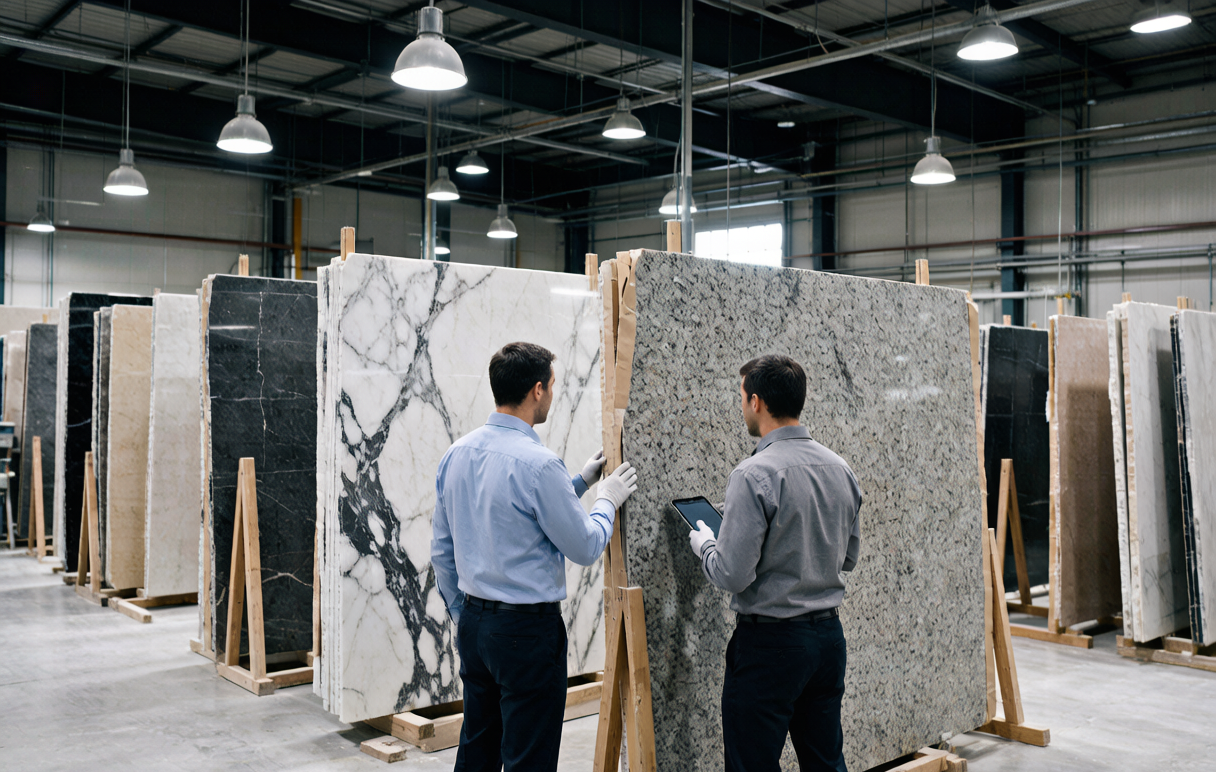
Inside a direct stone factory: block cutting, polishing, and QC inspection are handled under one roof.
What “Factory” and “Trading Company” Actually Mean
In China’s stone industry, a factory (manufacturer) owns or controls the processing line — cutting, polishing, calibration, and packing — and sells directly. A trading company does not process stone itself; it sources from one or more factories and resells, often bundling logistics and export paperwork. Both can be legitimate partners. The key is knowing which one you are dealing with so you can plan pricing, lead time, and risk accordingly.
Side-by-Side Comparison
| Factor | Direct Factory | Trading Company |
|---|---|---|
| Unit price | Lowest (no resale margin) | 8–20% higher (margin added) |
| Typical MOQ | 200–500 m² tiles; 50–100 m² slabs | Often 50–100 m² or mixed loads |
| Lead time | 15–45 days (controls schedule) | 20–55 days (depends on sub-suppliers) |
| Customization | Full (sizes, finishes, edge profiles) | Limited to what partner factories allow |
| Quality control | Direct, documented QC at source | Indirect; varies by sub-factory |
| Communication | Slower on export docs, technical depth | Faster English, export-savvy service |
| Payment leverage | Typically 30% deposit / 70% before shipment | Similar, sometimes stricter |
When a Direct Factory Makes More Sense
- Repeat volume orders where every dollar per m² compounds across the year.
- Project-specific specs — custom thickness, honed/leathered finishes, waterfall edges, or book-matched slabs.
- Long-term supply programs where color consistency across shipments matters.
- Buyers comfortable verifying a supplier via video call, third-party audit, or factory visit.
When a Trading Company Is the Smarter Choice
- Small or mixed first orders below a factory’s MOQ.
- Multi-product consolidations — stone plus tiles, faucets, or furniture in one shipment.
- Buyers new to importing who want an export-experienced partner to handle docs, inspection, and booking.
- Urgent, one-off jobs where speed and flexibility beat unit price.
Not every “factory” is a factory. Some trading companies rent a small workshop purely for show during visits. Verification — not the sales pitch — is what protects your order.
Red Flags to Watch For
- Refuses a live video tour of the production line or a third-party audit.
- Quotes wildly different prices for the same spec depending on the day.
- Has no fixed address matching the claimed facility on maps.
- Reluctant to share container-loading photos or QC reports.
- Pressure to pay 100% upfront or via irreversible methods only.
How to Verify You’re Dealing With a Real Factory
- Ask for a live video walkthrough of the cutting and polishing line, not just a showroom.
- Request business documents — unified social credit code, export license, and customs records where available.
- Order a small paid sample cut and finished as your real spec; a trader will often hesitate or subcontract.
- Check the loading photos — a factory loads its own branded or consistent packaging.
- Use a third-party inspection (SGS, TÜV, or a local agent) before final payment.
Why STONELINK Positions Itself as a Factory Partner
STONELINK operates as a manufacturer-exporter, meaning production and export are managed under one roof. For buyers, that translates to transparent pricing, documented in-house QC (material selection, thickness and flatness checks, finish grading, and packing inspection), and the ability to handle custom project specs at volume. We are happy to arrange video tours and third-party inspections — verification is part of building a long-term relationship, not an obstacle.
Frequently Asked Questions
Is a factory always cheaper than a trading company?
Usually yes on unit price (8–20% less), but only if your order clears the factory MOQ (commonly 200–500 m²). Below that, a trader’s ability to consolidate small runs can make the all-in cost comparable.
Can a trading company guarantee the same quality as a factory?
They can, but quality depends on which sub-factory they use. A factory controls its own line and QC, so consistency is easier to document and repeat across shipments.
What MOQ should I expect from a Chinese stone factory?
For tiles, 200–500 m² per color/spec is typical; for slabs, 50–100 m². Stock items may have lower minimums. Always confirm before budgeting.
How do I confirm a supplier is a real factory?
Request a live video tour of production, verify business registration, order a real-spec sample, review loading photos, and commission a third-party inspection before the balance payment.
What are common payment terms with a factory?
The industry standard is 30% deposit to start production and 70% before shipment, often via T/T. Some factories offer LC at sight for established buyers or large orders.
About the Source
STONELINK is a natural stone manufacturer and exporter based in China, supplying marble, granite, quartzite, and other natural stone products to importers, wholesalers, and project contractors worldwide. For procurement support, samples, or a tailored quotation, contact our team.
This guide is educational. Always verify current export policies, shipping rates, and supplier credentials before placing orders.