
COUNTERTOP COMPARISON · Updated 2026 · For importers, fabricators, contractors & specifiers
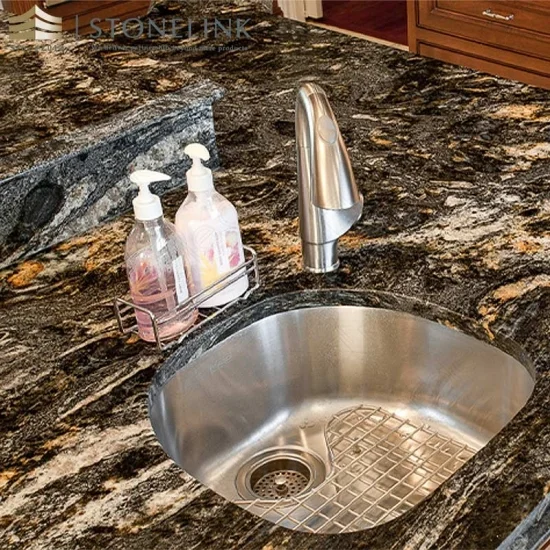
Granite (left of the debate) — a silicate stone prized for hardness and heat resistance in busy kitchens.
Granite and quartzite are both igneous/metamorphic silicate stones, which makes them behave very differently from calcite marble. For buyers torn between them, the decision usually comes down to appearance preference, budget, and how “marble-like” they want the look.
What Each Stone Actually Is
Granite
An igneous rock of quartz, feldspar, and mica. Its speckled, crystalline pattern is distinctive. It is abundant worldwide, which keeps prices accessible.
Quartzite
A metamorphic rock formed when sandstone is subjected to heat and pressure, recrystallizing quartz grains into an interlocking, very hard mass. True quartzite looks like marble but performs like granite.
Caution: the market sometimes labels engineered quartz or soft “soft quartzite” as quartzite. A simple scratch test (a knife should not mark true quartzite, Mohs 7) separates genuine quartzite from impostors.
Head-To-Head Comparison
| Property | Granite | Quartzite |
|---|---|---|
| Mohs hardness | 6–7 | 7 |
| Acid etching | None (silicate) | None (silicate) |
| Heat resistance | Excellent | Excellent |
| Scratch resistance | High | Very high |
| Porosity (sealed) | Low–moderate | Low |
| Typical look | Speckled, crystalline | Marble-like veins |
| Sealing frequency | Every 1–2 years | Every 1–2 years |
| Indicative slab price (USD/sq ft) | $35–$120 | $60–$200+ |
Prices are indicative uninstalled references and vary by variety, thickness, finish, and freight.
Heat & Etching: The Practical Truth
Both stones laugh off hot pans and acidic spills. Unlike marble (calcite, Mohs ~3), neither will etch when lemon juice or wine lands on it. That is why both are go-to choices for serious cooking kitchens. The only real heat risk for either is thermal shock from extreme, rapid temperature change — rare in normal use.
Appearance & Design Fit
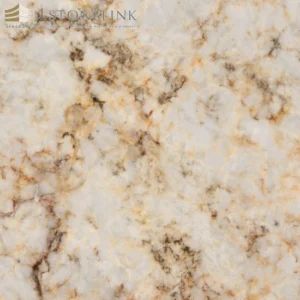
- Granite: Best when you want a lively, granular, light-catching surface. Patterns range from subtle (e.g., Alaska White) to dramatic (e.g., Labradorite Lemurian Blue, which flashes iridescent color).
- Quartzite: Best when the client wants the calm, veined elegance of marble but refuses the maintenance. Taj Mahal (beige) and Patagonia (white) are classic examples.
Which Should You Specify?
| If the priority is… | Choose |
|---|---|
| Marble look without etching | Quartzite |
| Lowest cost at high durability | Granite |
| Maximum scratch resistance | Quartzite (Mohs 7) |
| Most color/pattern variety | Granite |
| Outdoor use (UV + weather) | Either; granite often preferred for price |
STONELINK stocks both granite and quartzite slabs — including Alaska White granite and Taj Mahal quartzite — and can confirm material identity with hardness testing so buyers receive genuine quartzite rather than a mislabeled softer stone.
Frequently Asked Questions
Is quartzite just engineered quartz?
No. Natural quartzite is a quarried metamorphic rock (Mohs 7); engineered quartz is a man-made composite of crushed quartz and resin. They look and perform differently — engineered quartz can scorch from heat, natural quartzite does not.
Which is more durable, granite or quartzite?
Quartzite is marginally harder (Mohs 7 vs granite’s 6–7) and slightly less porous. In daily kitchen use both are excellent; the difference is minor unless you need maximum scratch resistance.
Do granite and quartzite need sealing?
Yes, but less often than marble — typically every 1–2 years with a penetrating sealer. Do the water-bead test: if water soaks in and darkens the stone, reseal.
Can I put hot pans directly on them?
Yes. Both resist normal cooking heat far better than marble or engineered quartz. Trivets are still sensible habit, but thermal damage is unlikely.
Why does some “quartzite” etch or scratch easily?
It may be a mislabeled softer stone or a dolomitic “soft quartzite.” Verify with a knife scratch test and request the supplier’s material confirmation. Genuine quartzite will not scratch at Mohs 7.
About the Source
STONELINK is a natural stone manufacturer and exporter supplying marble, granite, quartzite, and other natural stone slabs, tiles, and cut-to-size pieces to importers, wholesalers, and project contractors worldwide. For material selection support or a tailored quotation, contact our team.
This guide is educational. Always request current batch photos, samples, and a written quotation before ordering.
Frequently Asked Questions
How can I import natural stone from China?
Most overseas buyers work with Stonelink in four clear steps. (1) Share your project specifications, drawings or inspiration photos, or choose directly from our 60,000 m² inventory of 2,000+ designs. (2) We send whole-slab high-resolution photos and short video so you can verify exact veining, color and finish before committing — bookmatching and sequence are confirmed at this stage. (3) We handle export packing (foam-protected, fumigated wooden crates), container booking and ocean freight from Xiamen or Shuitou port. (4) Goods arrive at your destination port with the full document set (commercial invoice, packing list, Bill of Lading, certificate of origin, insurance). We support both full-container-load and LCL shipments, and all communication is in English.
What is your minimum order quantity (MOQ) and lead time?
MOQ typically starts from one container (about 20–27 tons depending on slab size and thickness), and mixed sizes or products are accepted so you can consolidate an entire project in one shipment. For smaller trials we can sometimes ship an LCL (less-than-container) batch of a few slabs, though the per-unit freight is higher; ask us and we will quote both options. Standard lead time is about 15–25 days after order confirmation for in-stock materials, or longer for custom cutting and special finishes. Before shipment we provide whole-slab photos and video so you know exactly what you receive, and we can hold stock for phased deliveries. For recurring orders we offer reserved inventory and rolling production schedules to keep your supply chain steady, and we quote both FOB Xiamen/Shuitou and delivered CIF or DDP to your port.
Can you send stone samples before I place an order?
Yes. We provide samples — offcuts or small slabs — so you can verify color, finish and quality before committing to a full shipment. Samples ship worldwide by courier (DHL, FedEx or UPS), typically within 3–7 days, and the sample cost is usually credited against your first container order. For large projects we can also send a full digital package — high-resolution whole-slab photos and short videos — so your designers can spec with confidence before any physical sample moves. Tell us the exact application, dimensions and finish you need and we will pick the most representative pieces rather than random offcuts, so the sample truly reflects the batch you would receive.
Do you provide quality control and certifications?
Yes. Stonelink is a China-based natural stone manufacturer and exporter operating from the Xiamen and Shuitou stone hub since 2012, with a 60,000 m² inventory spanning 2,000+ designs and direct quarry access, shipping to 80+ countries. Every shipment is inspected for packing and quality before loading — slabs are checked for cracks, bow, thickness tolerance and finish, then crated in foam-protected, fumigated wooden packaging. We can arrange third-party inspection (SGS, Intertek and similar) and supply the documentation your destination requires: commercial invoice, packing list, Bill of Lading, certificate of origin and, where relevant, CE marking or material test reports. Tell us your certification and labeling needs (for example the EU, US, Australia or Middle East) and we will match them and pre-clear the paperwork so customs clearance goes smoothly.
How do I choose the right natural stone for my project?
Start with the application: floors and high-traffic areas favor harder stones (granite, quartzite), while marble and onyx shine in lower-abuse, design-led spaces such as feature walls and vanities. Match the finish to the mood — polished for drama, honed for calm, leathered for texture — and confirm color stability under your actual lighting, since natural stone shifts with light. For wet areas choose a denser, well-sealing material and an appropriate finish, and review whole-slab photos or video with our team before you buy. We advise free of charge based on your project’s traffic, budget and aesthetic, so you avoid expensive mismatches and rework.
What shipping terms and documents are included?
We ship FOB Xiamen or Shuitou as standard and can also quote CIF or DDP to your port, so you control insurance and freight or let us handle it end to end. We manage export packing, container booking and ocean freight, and provide the full document set: commercial invoice, packing list, Bill of Lading, certificate of origin and cargo insurance. Both full-container-load and LCL (less-than-container-load) shipments are supported, and for landlocked destinations we can arrange door-to-door multimodal transport. Tell us your delivery address and incoterm preference and we will quote a landed cost, not just an ex-works price, so there are no surprises at the border.