
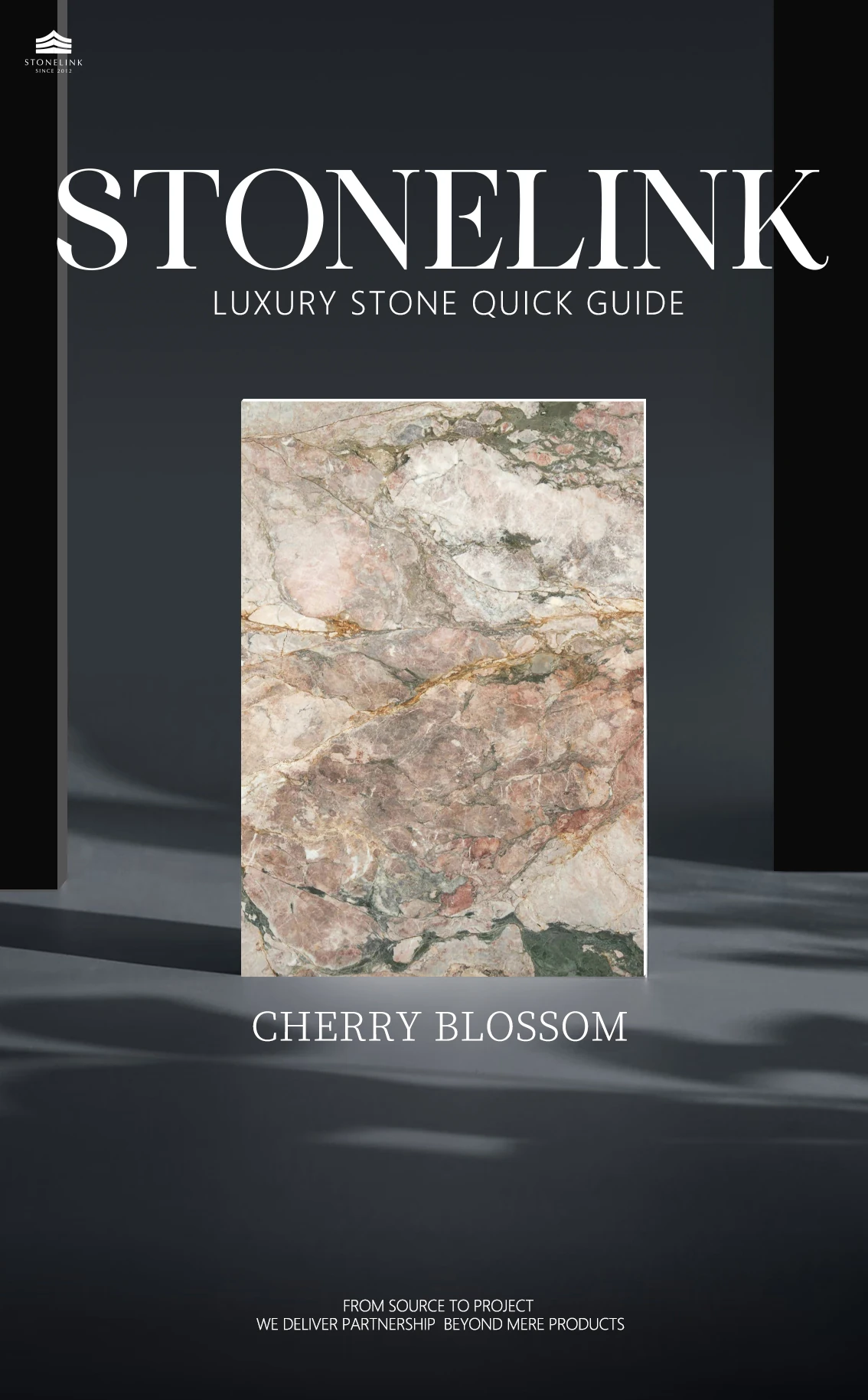
When architects and interior designers search for a stone that combines softness, drama, and timeless elegance, Cherry Blossom marble is increasingly at the top of their list. Named for its delicate pink palette that mirrors spring cherry blossoms, this dolomite-based marble brings a romantic, gallery-like quality to luxury residential, hospitality, and retail projects.
In this guide, we break down what Cherry Blossom marble is, what gives it its signature look, where it performs best, and what procurement teams should look for when sourcing slabs for large-scale projects.
What Is Cherry Blossom Marble?
Cherry Blossom is a dolomite-based marble prized for its silky, delicate, and smooth texture. Unlike harder calcitic marbles, dolomite marbles like Cherry Blossom tend to be slightly denser and more resistant to everyday etching, making them a practical choice for statement surfaces that still need to perform.
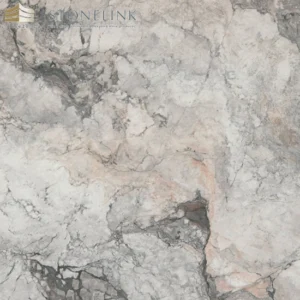
The stone’s most recognizable feature is its color gradient, which moves from pale blush pink through rose and deeper crimson tones, often interwoven with soft white, gold, gray, or light green veining. The overall effect resembles cherry blossoms blooming under morning light—hence the name.
Because of its warm, skin-like glow, Cherry Blossom marble is especially popular in spaces designed to feel intimate, serene, and poetic: luxury bathrooms, boutique hotel lobbies, high-end retail fitting rooms, and signature residential kitchens.
Mineral Composition: What Creates the Color?
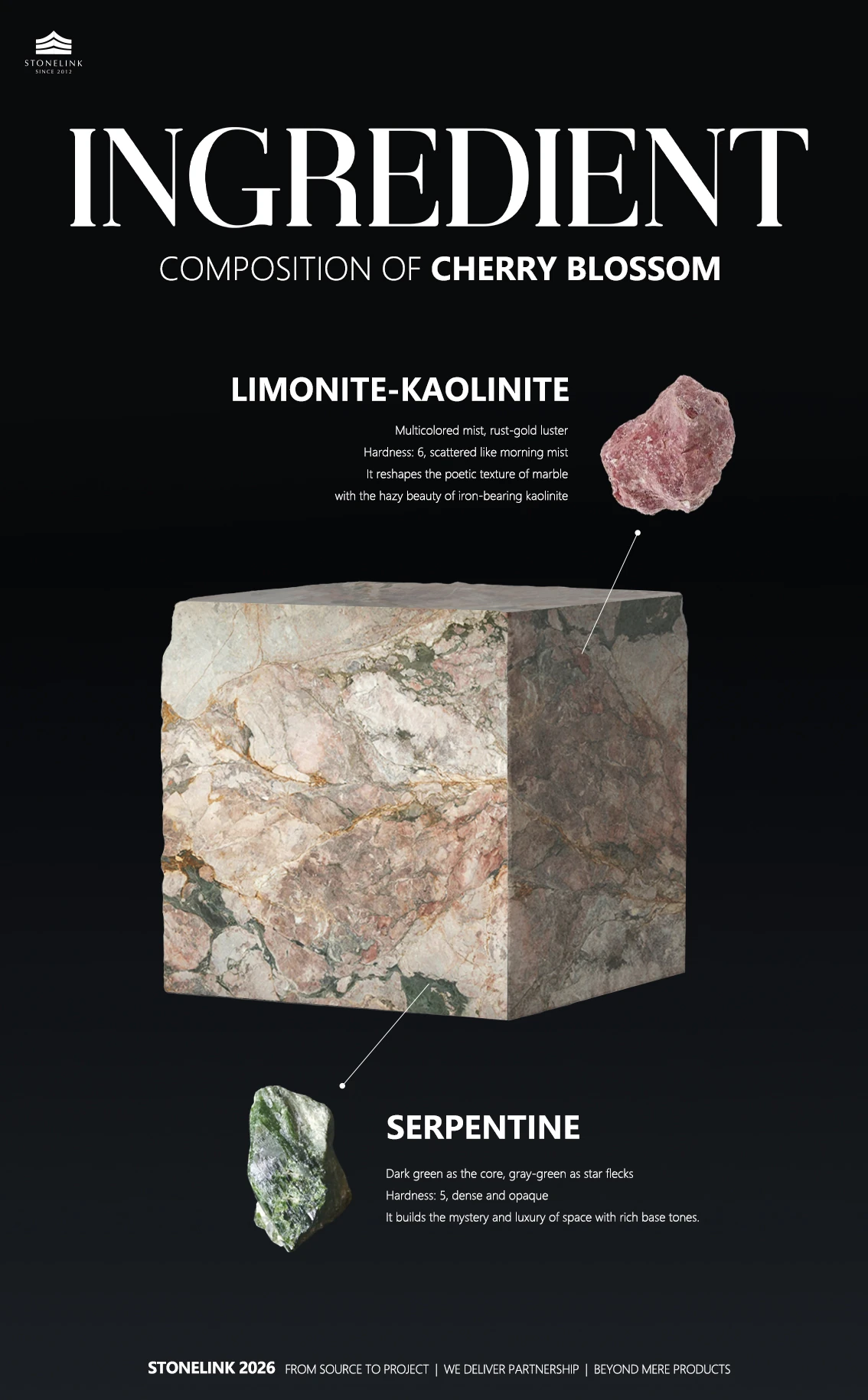
The visual character of Cherry Blossom marble comes from two key mineral contributors:
1. Limonite-Kaolinite
- Appearance: Multicolored mist with rust-gold luster
- Hardness: ~6 on the Mohs scale
- Effect: Scattered like morning mist across the slab, it reshapes the poetic texture of marble with the hazy beauty of iron-bearing kaolinite
2. Serpentine
- Appearance: Dark green core with gray-green star flecks
- Hardness: ~5 on the Mohs scale
- Effect: Dense and opaque, serpentine builds the mystery and luxury of the stone by introducing rich base tones that contrast against the pink matrix
Together, these minerals create the layered, almost painterly effect that distinguishes a high-quality Cherry Blossom slab from a generic pink marble.
Visual Features and Slab Character
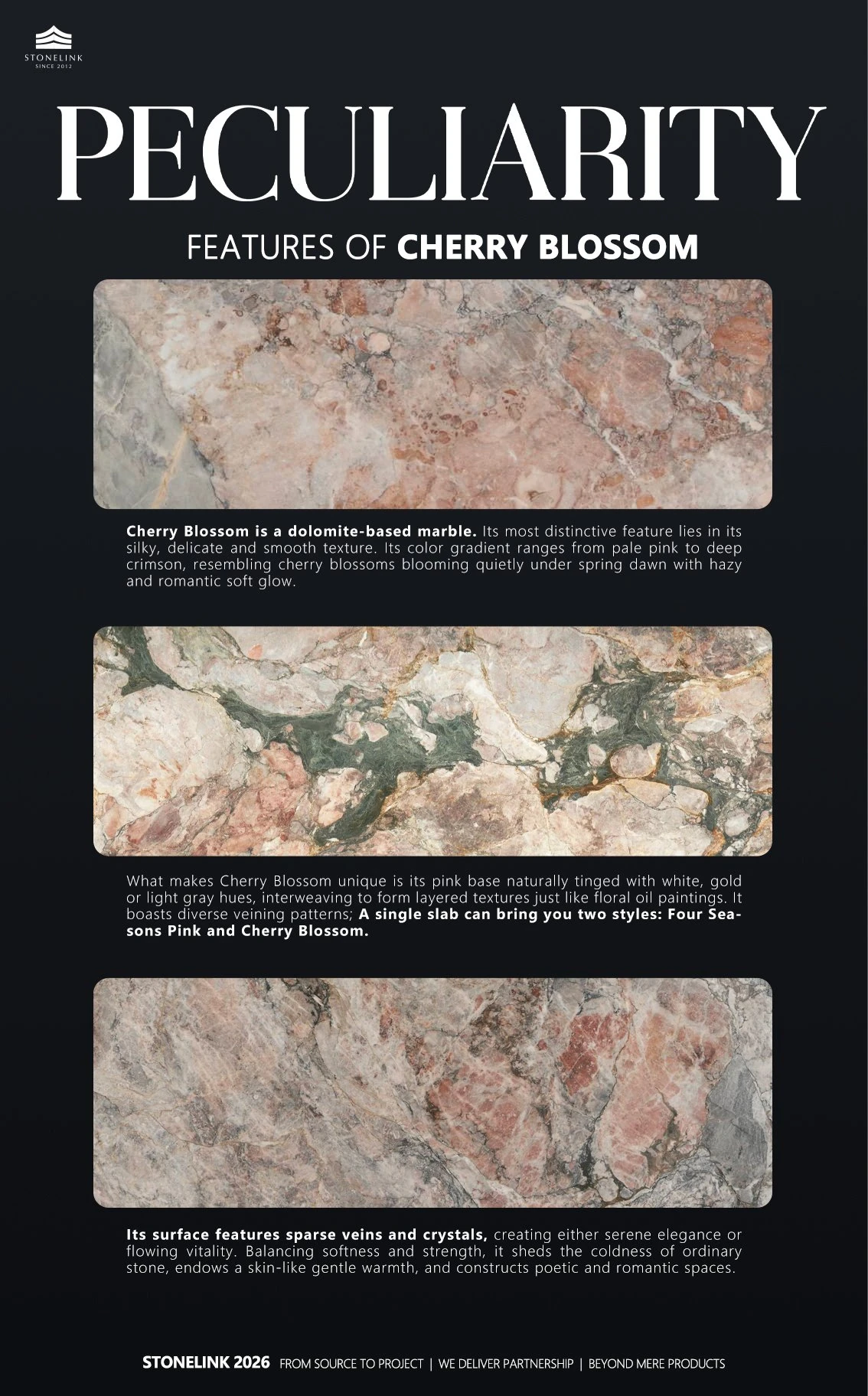
Cherry Blossom marble is not a monotone stone. Each slab is a unique composition of color and movement. The most distinctive visual traits include:
- Silky, smooth texture: The surface feels refined and almost skin-like, giving interiors a gentle warmth.
- Layered veining: Fine veins and crystals interweave like floral oil paintings, creating depth without overwhelming the design.
- Sparse crystals: Small crystalline pockets catch light and add subtle sparkle under direct illumination.
- Dual-style potential: Depending on how the block is cut, a single slab can read as either a soft Four Seasons Pink or the deeper, more dramatic Cherry Blossom face—effectively giving designers two aesthetics from one material.
This variability is an advantage for B2B buyers: the same quarry run can serve projects with different moods, from calm spa-like bathrooms to bold feature walls.
Best Applications for Cherry Blossom Marble
Thanks to its combination of beauty and moderate hardness, Cherry Blossom marble works well in both vertical and light-horizontal applications:
- Feature walls and TV backdrops: The large-format color movement becomes the room’s focal point.
- Bathroom vanities and shower cladding: The warm pink tone complements brass, matte black, and natural wood fittings.
- Hotel lobbies and reception desks: Creates an immediate sense of luxury and softness.
- Retail interiors and fitting rooms: Flatters skin tones and elevates product presentation.
- Bar fronts and restaurant accent walls: Pairs beautifully with warm lighting and velvet or leather seating.
For flooring in high-traffic commercial zones, we recommend consulting your stone supplier on finish selection. A honed or leathered finish can help mask wear better than a high-gloss polish in busy areas.
Sourcing and Quality Considerations
When buying Cherry Blossom marble slabs for commercial or residential projects, look for:
- Consistent background tone: The most valuable slabs have a clean pink base without muddy brown patches.
- Balanced veining: Avoid slabs with heavy, random fractures or unnatural-looking filler lines.
- Stable crystallization: Small, evenly scattered crystals add value; large, loose crystal pockets may weaken the slab.
- Correct thickness: Standard 18 mm or 20 mm slabs are suitable for most wall and vanity uses; 30 mm is preferred for countertops and heavy-use islands.
- Proper resin and mesh backing: Because it is a natural dolomite marble, professional backing improves handling and installation safety.
Working with a natural stone supplier that inspects blocks before cutting—rather than buying blindly from stock photos—greatly improves color consistency across a multi-slab project.
Why Architects and Distributors Source Cherry Blossom from Stonelink
At Stonelink, we supply Cherry Blossom marble slabs, tiles, and cut-to-size pieces direct from selected quarries. Our team photographs and measures each bundle so project teams can confirm tone, veining, and dimensions before shipment.
For B2B clients, we offer:
- Block-to-slab traceability
- Custom cutting for vanities, wall panels, and countertops
- Quality-controlled packaging for international shipping
- Competitive marble wholesale pricing for distributors and large developments
Whether you need a single statement slab or volume material for a hotel chain, we can match the right Cherry Blossom selection to your project specifications.
Frequently Asked Questions
Is Cherry Blossom marble durable enough for kitchen countertops?
It can be used for kitchen countertops in low- to moderate-use settings. For busy commercial kitchens, a harder stone like granite or quartzite may be more suitable.
What finishes are available?
Polished, honed, and leathered finishes are common. Polished highlights the color depth; honed and leathered offer a softer, more forgiving surface.
Can I get matching tiles and slabs from the same batch?
Yes. Sourcing slabs and cut-to-size pieces from the same block or bundle is the best way to ensure color consistency.
Conclusion
Cherry Blossom marble is more than a trend—it is a material that brings warmth, artistry, and calm luxury into a space. Its dolomite composition, distinctive mineral mix, and dual-style color potential make it a strong choice for designers who want a pink marble slab that performs as well as it photographs.
If you are sourcing Cherry Blossom marble for a hotel, residential, or retail project, contact Stonelink for slab photos, technical specifications, and a tailored quotation.
Looking for more stone guides? Explore our guides to Breccia Lunare, Four Seasons Pink, and other luxury marble varieties.
For slab availability, sizes, and pricing, visit the Cherry Blossom marble slab product page.
Frequently Asked Questions
How can I import natural stone from China?
Most overseas buyers work with Stonelink in four clear steps. (1) Share your project specifications, drawings or inspiration photos, or choose directly from our 60,000 m² inventory of 2,000+ designs. (2) We send whole-slab high-resolution photos and short video so you can verify exact veining, color and finish before committing — bookmatching and sequence are confirmed at this stage. (3) We handle export packing (foam-protected, fumigated wooden crates), container booking and ocean freight from Xiamen or Shuitou port. (4) Goods arrive at your destination port with the full document set (commercial invoice, packing list, Bill of Lading, certificate of origin, insurance). We support both full-container-load and LCL shipments, and all communication is in English.
What is your minimum order quantity (MOQ) and lead time?
MOQ typically starts from one container (about 20–27 tons depending on slab size and thickness), and mixed sizes or products are accepted so you can consolidate an entire project in one shipment. For smaller trials we can sometimes ship an LCL (less-than-container) batch of a few slabs, though the per-unit freight is higher; ask us and we will quote both options. Standard lead time is about 15–25 days after order confirmation for in-stock materials, or longer for custom cutting and special finishes. Before shipment we provide whole-slab photos and video so you know exactly what you receive, and we can hold stock for phased deliveries. For recurring orders we offer reserved inventory and rolling production schedules to keep your supply chain steady, and we quote both FOB Xiamen/Shuitou and delivered CIF or DDP to your port.
Can you send stone samples before I place an order?
Yes. We provide samples — offcuts or small slabs — so you can verify color, finish and quality before committing to a full shipment. Samples ship worldwide by courier (DHL, FedEx or UPS), typically within 3–7 days, and the sample cost is usually credited against your first container order. For large projects we can also send a full digital package — high-resolution whole-slab photos and short videos — so your designers can spec with confidence before any physical sample moves. Tell us the exact application, dimensions and finish you need and we will pick the most representative pieces rather than random offcuts, so the sample truly reflects the batch you would receive.
Do you provide quality control and certifications?
Yes. Stonelink is a China-based natural stone manufacturer and exporter operating from the Xiamen and Shuitou stone hub since 2012, with a 60,000 m² inventory spanning 2,000+ designs and direct quarry access, shipping to 80+ countries. Every shipment is inspected for packing and quality before loading — slabs are checked for cracks, bow, thickness tolerance and finish, then crated in foam-protected, fumigated wooden packaging. We can arrange third-party inspection (SGS, Intertek and similar) and supply the documentation your destination requires: commercial invoice, packing list, Bill of Lading, certificate of origin and, where relevant, CE marking or material test reports. Tell us your certification and labeling needs (for example the EU, US, Australia or Middle East) and we will match them and pre-clear the paperwork so customs clearance goes smoothly.
How do I choose the right natural stone for my project?
Start with the application: floors and high-traffic areas favor harder stones (granite, quartzite), while marble and onyx shine in lower-abuse, design-led spaces such as feature walls and vanities. Match the finish to the mood — polished for drama, honed for calm, leathered for texture — and confirm color stability under your actual lighting, since natural stone shifts with light. For wet areas choose a denser, well-sealing material and an appropriate finish, and review whole-slab photos or video with our team before you buy. We advise free of charge based on your project’s traffic, budget and aesthetic, so you avoid expensive mismatches and rework.
What shipping terms and documents are included?
We ship FOB Xiamen or Shuitou as standard and can also quote CIF or DDP to your port, so you control insurance and freight or let us handle it end to end. We manage export packing, container booking and ocean freight, and provide the full document set: commercial invoice, packing list, Bill of Lading, certificate of origin and cargo insurance. Both full-container-load and LCL (less-than-container-load) shipments are supported, and for landlocked destinations we can arrange door-to-door multimodal transport. Tell us your delivery address and incoterm preference and we will quote a landed cost, not just an ex-works price, so there are no surprises at the border.