
EXTERIOR & CLADDING · Updated 2026 · For importers, fabricators, contractors & specifiers
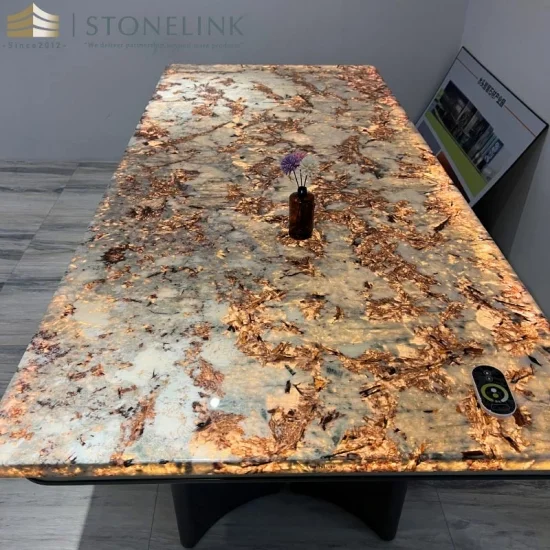
Granite is the workhorse of outdoor stone — UV-stable, dense, and unfazed by freeze-thaw and salt.
Outdoor stone lives a harder life than indoor stone: year-round UV, temperature swings, rain, and near coastlines, salt spray. The wrong material will spall, fade, or dissolve in a few seasons. The right one will outlast the building.
What Outdoor Stone Must Survive
- UV stability: Pigments and resins must not fade. Natural stone has no coating to peel, but some light-colored stones can yellow if resin-treated — specify untreated natural slabs.
- Freeze-thaw: Water entering pores expands when frozen. Porous stone cracks and spalls. Low absorption is critical in cold climates.
- Salt resistance: Coastal salt accelerates weathering and corrosion at fixings. Dense, non-absorbent stone performs best.
- Porosity: Lower water absorption means less staining, less freeze damage, less biological growth.
Best Choices For Outdoors
Granite (top pick)
A silicate igneous rock (Mohs 6–7) with very low water absorption (typically under 0.4%). It shrugs off UV, salt, and freeze-thaw, making it the default for outdoor countertops, cladding, and pool copings.
Quartzite (excellent, marble-like)
Also silicate (Mohs 7) and dense. It gives the veined marble look outdoors without the etching. Verify it is true quartzite, not a soft impostor.
Some dense limestone / basalt (climate-dependent)
Certain dense basalts and some limestones work in mild, non-freezing, low-salt locations, but they are more porous than granite and need careful sealing.
Stone To Avoid Outdoors
- Marble (calcite, Mohs ~3): Etches from acid rain and bird droppings, weathers and loses polish, and is too soft for exposed paving in harsh climates.
- Onyx: Extremely fragile, highly translucent, and prone to cracking; strictly an interior feature or backlit wall stone.
- Soft, high-porosity stone: Sandstone and travertine can work in dry, mild settings but need frequent sealing and are poor in freeze-thaw or salt zones.
Outdoor Suitability Table
| Stone | Mohs | Water absorption | UV stable | Freeze-thaw | Coastal salt | Outdoor verdict |
|---|---|---|---|---|---|---|
| Granite | 6–7 | Very low (<0.4%) | Yes | Excellent | Excellent | Best |
| Quartzite | 7 | Low | Yes | Excellent | Excellent | Best |
| Dense basalt | 6–7 | Low | Yes | Good | Good | Good (mild climates) |
| Marble | ~3 | Moderate | Yellows/etches | Poor | Poor | Avoid |
| Travertine | ~3–4 | High | Fades | Fair (sealed) | Fair | Dry/mild only |
| Onyx | ~3 | Moderate | Brittle | Very poor | Poor | Do not use |
Finish & Installation Notes
- Finish: Use honed or leathered outdoors — polished is slippery when wet and shows wear. Leathered also hides weathering.
- Sealing: Even granite benefits from a penetrating sealer every 1–2 years outdoors, more often in harsh sun or salt.
- Fixings: Use stainless or compatible anchors to avoid rust stains, especially in coastal salt environments.
- Thickness: Outdoor tops and cladding often need 3 cm (or laminated) thickness for rigidity and thermal movement.
For coastal or freeze-thaw projects, granite is the lowest-risk specification. It is dense, hard, and chemically inert — the stone equivalent of “set and forget.”
STONELINK supplies granite and quartzite suitable for exterior use and can advise on finish and thickness for cladding and outdoor kitchen projects, including salt-exposure and freeze-thaw conditions.
Frequently Asked Questions
Can I use marble for an outdoor kitchen?
Not advised. Marble is calcite (Mohs ~3), etches from acid rain and food acids, and weathers outdoors. Use granite or quartzite instead for durability and looks that last.
Is quartzite safe in freeze-thaw climates?
Yes, if it is genuine quartzite (Mohs 7, low absorption). Confirm material identity, specify a honed/leathered finish, and seal every 1–2 years. Avoid mislabeled soft stones.
What finish is best for outdoor stone?
Honed or leathered. Both improve slip resistance when wet and camouflage weathering better than polished, which becomes slippery and shows wear.
Does outdoor granite need sealing?
Yes, periodically. Though dense, a penetrating sealer every 1–2 years (more in harsh sun or salt) prevents staining and eases cleaning. The water-bead test tells you when.
Can onyx be used outside at all?
No. Onyx is too soft and brittle, cracks under thermal and impact stress, and is strictly for interior feature or backlit walls. Never specify it for exterior cladding or paving.
About the Source
STONELINK is a natural stone manufacturer and exporter supplying marble, granite, quartzite, and other natural stone slabs, tiles, and cut-to-size pieces to importers, wholesalers, and project contractors worldwide. For material selection support or a tailored quotation, contact our team.
This guide is educational. Always request current batch photos, samples, and a written quotation before ordering.
Frequently Asked Questions
How can I import natural stone from China?
Most overseas buyers work with Stonelink in four clear steps. (1) Share your project specifications, drawings or inspiration photos, or choose directly from our 60,000 m² inventory of 2,000+ designs. (2) We send whole-slab high-resolution photos and short video so you can verify exact veining, color and finish before committing — bookmatching and sequence are confirmed at this stage. (3) We handle export packing (foam-protected, fumigated wooden crates), container booking and ocean freight from Xiamen or Shuitou port. (4) Goods arrive at your destination port with the full document set (commercial invoice, packing list, Bill of Lading, certificate of origin, insurance). We support both full-container-load and LCL shipments, and all communication is in English.
What is your minimum order quantity (MOQ) and lead time?
MOQ typically starts from one container (about 20–27 tons depending on slab size and thickness), and mixed sizes or products are accepted so you can consolidate an entire project in one shipment. For smaller trials we can sometimes ship an LCL (less-than-container) batch of a few slabs, though the per-unit freight is higher; ask us and we will quote both options. Standard lead time is about 15–25 days after order confirmation for in-stock materials, or longer for custom cutting and special finishes. Before shipment we provide whole-slab photos and video so you know exactly what you receive, and we can hold stock for phased deliveries. For recurring orders we offer reserved inventory and rolling production schedules to keep your supply chain steady, and we quote both FOB Xiamen/Shuitou and delivered CIF or DDP to your port.
Can you send stone samples before I place an order?
Yes. We provide samples — offcuts or small slabs — so you can verify color, finish and quality before committing to a full shipment. Samples ship worldwide by courier (DHL, FedEx or UPS), typically within 3–7 days, and the sample cost is usually credited against your first container order. For large projects we can also send a full digital package — high-resolution whole-slab photos and short videos — so your designers can spec with confidence before any physical sample moves. Tell us the exact application, dimensions and finish you need and we will pick the most representative pieces rather than random offcuts, so the sample truly reflects the batch you would receive.
Do you provide quality control and certifications?
Yes. Stonelink is a China-based natural stone manufacturer and exporter operating from the Xiamen and Shuitou stone hub since 2012, with a 60,000 m² inventory spanning 2,000+ designs and direct quarry access, shipping to 80+ countries. Every shipment is inspected for packing and quality before loading — slabs are checked for cracks, bow, thickness tolerance and finish, then crated in foam-protected, fumigated wooden packaging. We can arrange third-party inspection (SGS, Intertek and similar) and supply the documentation your destination requires: commercial invoice, packing list, Bill of Lading, certificate of origin and, where relevant, CE marking or material test reports. Tell us your certification and labeling needs (for example the EU, US, Australia or Middle East) and we will match them and pre-clear the paperwork so customs clearance goes smoothly.
How do I choose the right natural stone for my project?
Start with the application: floors and high-traffic areas favor harder stones (granite, quartzite), while marble and onyx shine in lower-abuse, design-led spaces such as feature walls and vanities. Match the finish to the mood — polished for drama, honed for calm, leathered for texture — and confirm color stability under your actual lighting, since natural stone shifts with light. For wet areas choose a denser, well-sealing material and an appropriate finish, and review whole-slab photos or video with our team before you buy. We advise free of charge based on your project’s traffic, budget and aesthetic, so you avoid expensive mismatches and rework.
What shipping terms and documents are included?
We ship FOB Xiamen or Shuitou as standard and can also quote CIF or DDP to your port, so you control insurance and freight or let us handle it end to end. We manage export packing, container booking and ocean freight, and provide the full document set: commercial invoice, packing list, Bill of Lading, certificate of origin and cargo insurance. Both full-container-load and LCL (less-than-container-load) shipments are supported, and for landlocked destinations we can arrange door-to-door multimodal transport. Tell us your delivery address and incoterm preference and we will quote a landed cost, not just an ex-works price, so there are no surprises at the border.